
ARTICLES
Yuko Hasegawa × Kengo Kuma Session Report: The Future of Architecture Driven by Nature, Sensibility, and Materials
2026.06.15
REPORT

The exhibition "MAKERU" by Kengo Kuma is currently on view at the New Art Museum Singapore. To commemorate this occasion, a dialogue was held between Yuko Hasegawa, the curator of the exhibition, and Kengo Kuma.
At the opening of the session, Hasegawa positioned the exhibition as "the first large-scale and comprehensive exhibition in Southeast Asia in Singapore," noting that it also places a particular focus on Asia — and China in particular. From there, she broadened the conversation to encompass the Founders' Memorial and architecture across Asia as a whole, drawing out the underlying perspective that runs through Kuma's work. This article presents a digest of the wide-ranging and insightful session.
A Silhouette Rooted in the Landscape: The Founders' Memorial and the Garden City

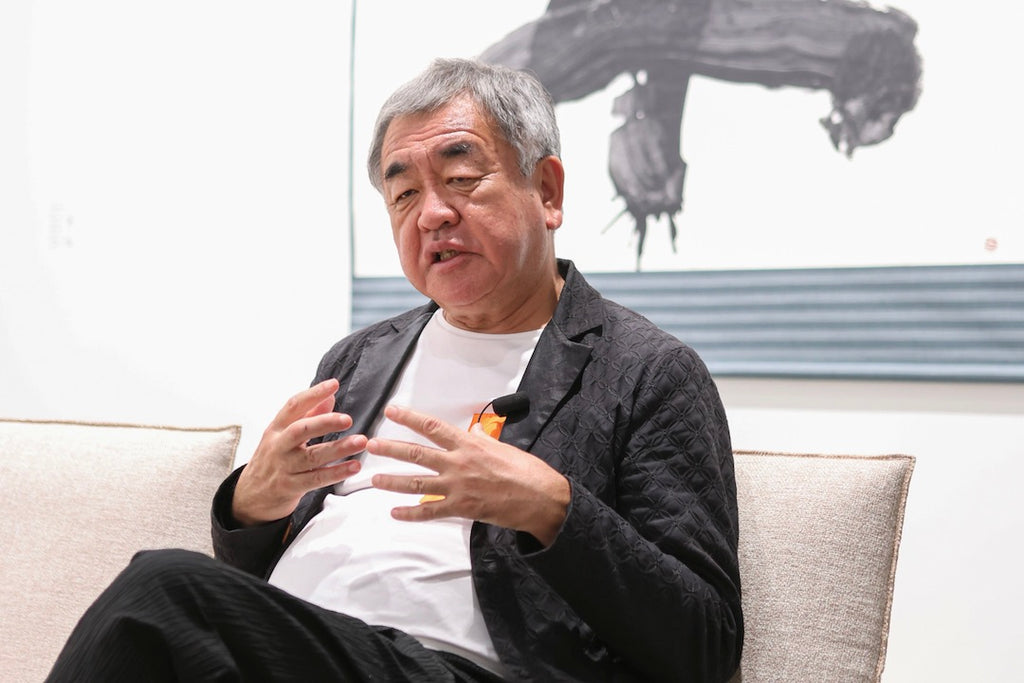
Yuko Hasegawa and Kengo Kuma during the session
The first topic Hasegawa raised was Singapore's Founders' Memorial — a monument dedicated to honoring the figures who played pivotal roles in Singapore's early nationhood, including the country's first Prime Minister, the late Mr Lee Kuan Yew. A competition was held in 2019, and the joint proposal by Kengo Kuma & Associates and K2LD Architects was selected as the winning entry.
When Hasegawa asked how Kuma perceives Singapore and where the ideas behind this project originated, Kuma began by speaking about his foundational impressions of Singapore.
He recalled his first visit in the 1980s — around 1985 or 1986 — and described the city as "totally different from Japan" and "a kind of paradise." He went on to say that after returning many times, the Founders' Memorial became "the first public building we designed in Singapore." The planning and schematic design process spanned approximately ten years, illustrating how long the concept was given to mature.
At the core of the project, Kuma pointed to Mr Lee Kuan Yew's concept of the "Garden City." He highlighted the remarkable fact that Mr Lee Kuan Yew had already articulated ideas connected to environmental design and sustainability back in the 1960s, calling him "a kind of pioneer of environmental design." While many entries in the international competition gravitated toward symbols and monuments, Kuma explained that his own proposal was "very much connected with the landscape." Taking into account the site's view directly facing Marina Bay Sands, he described his intention to create a deliberate contrast between the surrounding high-rise buildings and his own low-silhouette structure. For Kuma, that low silhouette was the element that "can show the future of Singapore."
Hasegawa responded by noting that the Garden City philosophy is "very important to the world," and that Kuma's proposal "succeeded in his original founders' idea to fit into the landscape." She described it as a kind of moderating transformation process — a gentle evolution of how the future Singapore and its cityscape might unfold.
Structure and Craftsmanship Connecting the Landscape: The Jeffrey Bawa Monument and Kithul

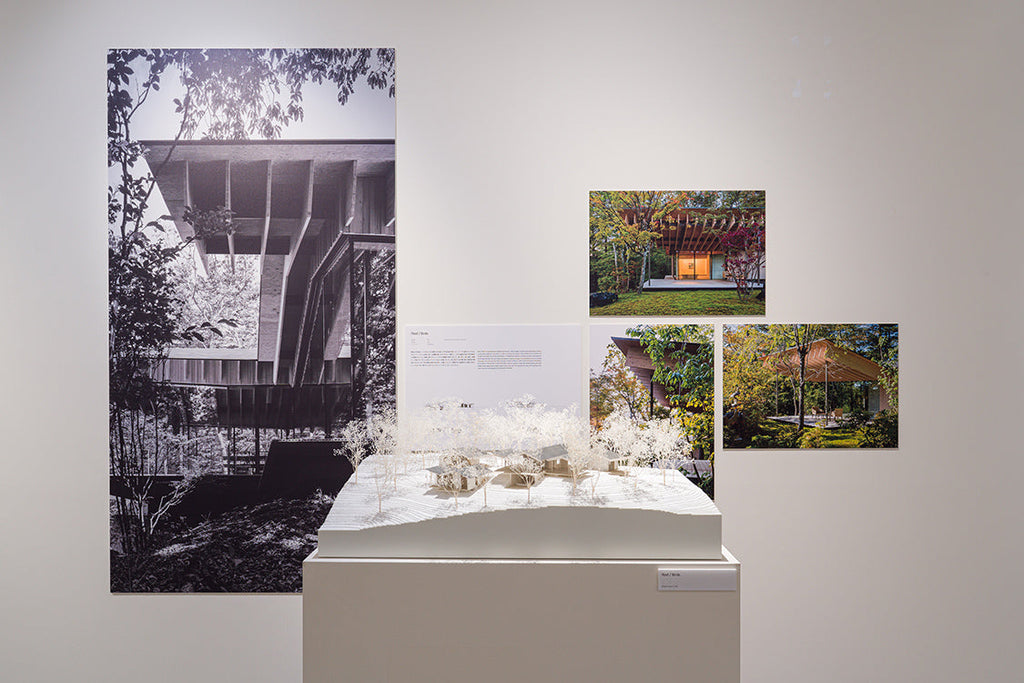
Model of the monument
The conversation then turned to the monument created for the 100th anniversary of the birth of Geoffrey Bawa, located at Lunuganga in Sri Lanka. Bawa is one of Sri Lanka's most celebrated architects, known for advocating "Tropical Modernism" — a fusion of the architectural traditions of the tropics with Western Modernism. Lunuganga was the vast garden estate and private villa that Bawa himself created.
Kuma described this project as one driven by collaboration with local craftmen. He spoke of visiting Sri Lanka and being deeply moved by Bawa's own villa — the place Bawa had designed himself, lived in for many years, and where he ultimately passed away, with his grave situated within the garden itself.
The concept for the monument took shape as Kuma walked through the grounds of Lunuganga. In Bawa's living room, he discovered a small basket made from a plant called Kithul — a type of palm tree whose flowers produce long strands of fiber. He then learned from a local elderly woman who was exceptionally skilled at weaving baskets from Kithul. In this way, the materials and the memory of handcraft rooted in that place became woven into the monument itself.
Hasegawa introduced this as a project that clearly reflects Kuma's methodology — one in which he personally discovers, observes, and investigates local materials such as Kithul.
Regarding the form of the monument, Kuma was emphatic: "It's not arbitrary shape. It is a meaningful shape." Structurally, it is a functional form in which the tension and compression of a steel frame are held in balance, with Kithul fabric fixed onto that frame. Hasegawa found it "very interesting" that the name of the material appears directly in the title, and this detail left a strong impression of the intimacy the monument holds with its place.
Kuma also described Bawa as someone who "was working as a bridge between West and East." Born in Sri Lanka and educated in the United Kingdom — not at an architecture school, but at law school — Bawa's self-taught quality was something Kuma suggested may have been an asset to his creativity. "I learned many things from him," Kuma said, "and it was a great honor for me to have the chance to design his monument."
Waste Materials and Timber Speaking the Present: The Fire Watchtower in Kalimantan

Model of The Fire Watchtower
Next, the conversation moved to the fire watchtower on the island of Kalimantan. Hasegawa drew attention to the way Kuma had transformed what would typically be a purely functional structure — built from concrete or steel — by using regional materials and natural local forms, and she asked him to describe the process.
Kuma began by explaining that the tropical rainforest of Kalimantan has been ravaged by fires, development, and unplanned expansion. The client wished to preserve this forest as Indonesia's precious rainforest treasure, and Kuma responded with a proposal conceived as a monument. "As a monument," he insisted, "it should show itself by itself. Without explanation." The combination of timber planks, wood, and waste plastic was intended to reveal the actual condition of the forest — not merely a watchtower, but a presence that makes visible what is happening within it.
Hasegawa emphasized that the very reason a fire watchtower is necessary is itself significant. The forest, she noted, is the lung of the earth — Kalimantan being the second largest rainforest after the Amazon — and the tower draws people's attention to the importance of protecting it. "This is very much psychological," she said, "and there is a very important statement about ecological protection here." She read Kuma's work not simply as form-making, but as a device connecting the ecosystem to human consciousness.
Bamboo Opening the Door to China: Great (Bamboo) Wall

Model of the Great (Bamboo) Wall
The first project Kuma undertook in China was the Great (Bamboo) Wall. He introduced it with the words: "This is an unforgettable project."
His first site visit was in December 1998. The client was a young developer who had recently left Goldman Sachs and struck out on her own. The conditions were severe: temperatures of minus 30 degrees Celsius, and a request to complete the building by the following May.
When Hasegawa asked, "So you said yes?" Kuma replied, "But actually, I didn't say no." He told the client, "I want to respect your schedule," and she was, he said, very pleased with the answer. The budget was also "very, very small," and under these circumstances Kuma proposed the use of bamboo. He had been worried that the client might object, but her response was: "Oh, bamboo is an interesting material." The reason was straightforward: "Bamboo is cheap."
Even so, using bamboo for a permanent building in China was no simple matter. In construction, bamboo is used for scaffolding, and most construction companies in China dismissed it as suitable only for temporary, not permanent, structures. Kuma turned to a Kyoto carpenter — a friend who was a specialist in bamboo — for help, and the project finally moved forward. The building ultimately took four years to complete, not six months, but Kuma spoke of it as the starting point for everything that followed in China.
Hasegawa observed that the use of bamboo recalls "the early tea house," drawing a parallel to the era of Sen no Rikyu, when the cheapest available materials — earth and bamboo — were deliberately chosen. Kuma acknowledged that sustainability was not yet a major concern in China at the time, but noted that the building received a very positive response upon completion, and that its image was ultimately used in the opening ceremony of the 2008 Beijing Olympics by renowned film director Zhang Yimou.
Hasegawa also noted that Kuma's architecture does not start by "creating a form and then finding a reason," but rather by "creating a reason" from which a regional aesthetic naturally emerges.
Kenzo Tange, Singapore, and a Childhood Resolution

Kengo Kuma
One of the central pillars of the latter half of the session was a comparison between the National Stadium and the work of Kenzo Tange. Hasegawa noted that the original stadium had been designed by Tange and was of great significance to the Tokyo Olympics, and she asked how Kuma had inherited, transformed, and ultimately converted that legacy into a model for the future.
Kuma began by noting that Kenzo Tange and Mr Lee Kuan Yew had been friends — they met at an awards ceremony in Hong Kong in the late 1960s and became close — which is how Tange came to design several buildings in Singapore. He then described a defining characteristic of Tange's postwar architecture: "column, column, vertical, vertical." By deliberately making visible columns that were not structurally necessary in large-span spaces such as gymnasiums and swimming pools, Tange created a sense of monumentality within the city. "Japan in the 1960s needed the vertical element," Kuma said. "And Singapore was the same" — a city that had once been defined by low-rise shophouses and villas.
Kuma then shared a personal memory: at the age of ten, in 1964, his father took him to the Tokyo Olympics, and he was profoundly shocked by Tange's building. He asked his father who had designed it, and was told: the architect Kenzo Tange.
"Okay. I will become an architect," he said. "I decided that day."
"I Wanted to Go in the Opposite Direction from Kenzo Tange": The National Stadium and Horizontality

Session scene
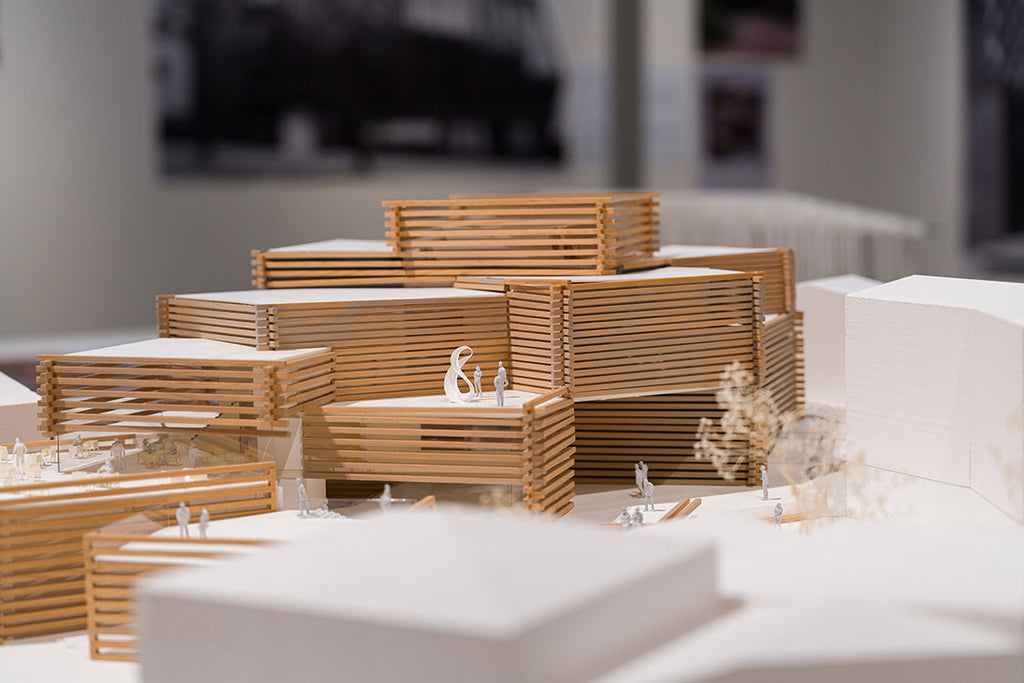
And yet, when it came to his own project for the 2021 Tokyo Olympics, Kuma stated plainly: "I wanted to go in the opposite direction from Kenzo Tange." Touching the heart remained important, he said, but in terms of material and form, he aimed for the complete opposite. When Hasegawa offered the word "horizontality," Kuma confirmed: "Horizontality, natural material, totally opposite."
He also introduced an intriguing episode: Tange, it seems, did not like trees alongside his buildings. "He always said the building should be the protagonist of the environment. If a tree hides the building, it is not good for the building." For Kuma, however, "to hide the building by vegetation is a very natural solution" for a project of such enormous scale.
He then spoke of a series of horizontal eaves — like a pagoda. The pagoda, he explained, is an Asian creation. In Asia, rain is heavy and sunlight is strong; wood must be protected by a succession of roofs. "Shadow is very important in Asia," Kuma said. A wooden building constructed in the seventh century has survived for 1,400 years — and the secret, he argued, is shadow. "Shadow actually protects this building for 1,400 years."
He then cited a second secret: "small particles, small unit." The wood is not used in large masses; it is broken down into small, fine units. "Small particles," he said, "means it is easy to recycle." Individual elements can be checked and replaced. "Even in seven centuries, the Asian people know how to create a sustainable building," he concluded. "Asia has a wisdom of sustainability."
Hasegawa connected this to an earlier point about the eaves, noting that the public promenade proposed for the National Stadium — a space that requires no ticket and is open to all — embodies the same spirit of "generosity" and openness.
"Bara Bara, More Bara Bara": Onomatopoeia and Tomonami

Model of The National Stadium
Toward the end of the session, the conversation turned to onomatopoeia — a subject Kuma has placed increasing emphasis on in recent years. The multi-colored seats of the National Stadium came up as an example: the "bara bara" (scattered) effect of multiple colors makes the stadium look full of people even at night when no one is there. Hasegawa asked how significant onomatopoeia — as a form of special expressive sound — is to his creative process.
Kuma explained that onomatopoeia is not unique to Japan; its origins lie in ancient Greece. The word means "creating a word," and more specifically, "creating a word from the atmosphere." It occupies a space between logic and sensibility.
He noted that Japanese, the Basque language, and various African languages all make extensive use of onomatopoeia, and offered his own theory: "The number of onomatopoeia is showing the closeness to nature." In Japan, nature is very close; in Africa, people live within nature. That proximity to the natural world, he suggested, enriches the sense of sound.
For roughly the past twenty years, Kuma's office has used onomatopoeia in its internal communication. Saying "bara bara, motto bara bara ni" (scattered, even more scattered) conveys an impression to staff far more easily than technical description. But onomatopoeia is also inherently ambiguous — which led to the collaboration with Sony on an onomatopoeia project called "Tomonami."
Kuma referred to the machine on display at the exhibition as an "architectural DJ." In it, geometry, texture, atmosphere, and scale are all controlled simultaneously. Rather than the conventional architectural design sequence — first establishing volume, then applying textures as a final step — everything is combined from the outset. "It is real, as a DJ in architectural design," he said.
Hasegawa described it as "a DJ practice — a method of learning the rhythm and materials and a lot of the particles through this onomatopoeia machine." The onomatopoeic terms presented in the exhibition — para-para, pata-pata, zure-zure, tsun-tsun, suke-suke, guru-guru — were also applied to the Founders' Memorial project. This endeavor — connecting sensation and language, material and geometry — was presented as a way of making Kuma's architectural thinking visible from a new angle.

The machine in the foreground, nicknamed the "architectural DJ," controls the visuals projected in the background.
The session covered an exceptionally wide range of ground, but what emerged across the entire dialogue was a consistent design philosophy: one that prizes connection to landscape over formal strength, a low silhouette over grand monumentality, and a weaving together of materials, craftspeople, environment, and bodily sensation.
Through this conversation, Hasegawa distilled her observation that "architecture's grammar and logic are very much connected not only to words, but also to sensation." Strong observation, rigorous research into materials and environment — these, she concluded, come together "to model the future architecture and to state it from Asia." On that note, the session between the two came to a close.
RELATED ARTICLES
ARTICLES CATEGORY

