
ARTICLES
A Narrative of Water Connecting Places: Ronald Ventura on Dialogue and Memory at the Venice Biennale
2026.10.01
INTERVIEW

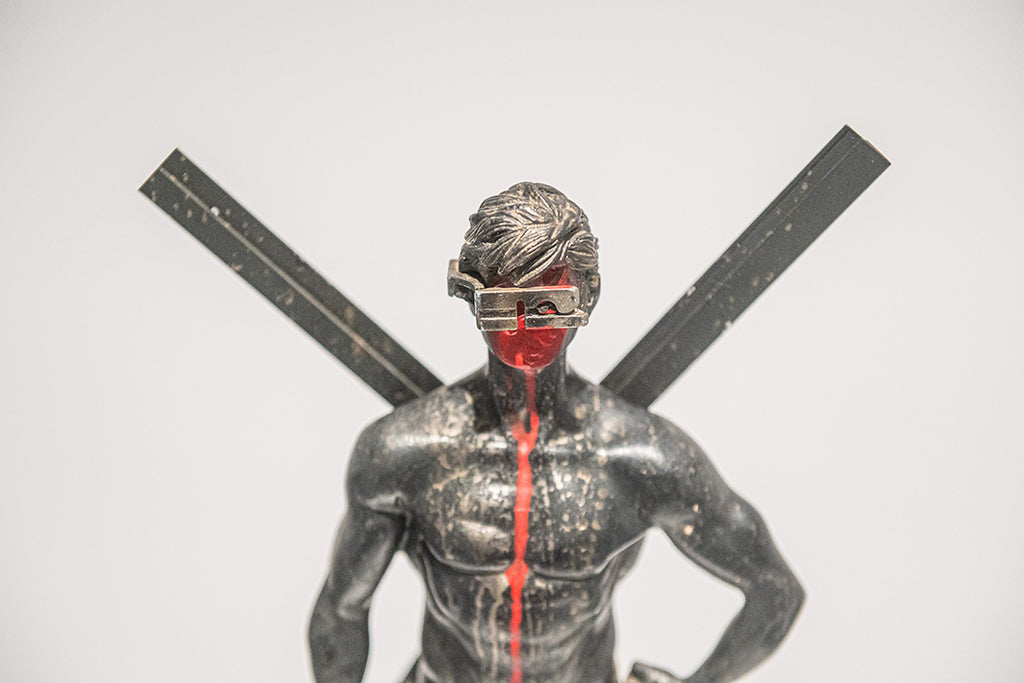
Ronald Ventura is a Filipino contemporary artist internationally acclaimed as one of Asia’s leading figures in contemporary art, best known for his signature style, which brings contrasting imagery together within a single canvas. He is currently presenting his solo exhibition, Luna, curated by Ruel Caasi, at Docks Cantiere Cucchini in Venice. The exhibition runs as a Collateral Event of the 61st Venice Biennale, from May 9 to November 22, 2026.
For this feature, we sat down with Ventura for an exclusive interview to discuss the inspiration behind the exhibition, his creative process, and his artistic journey at this stage of his career.
Questioning Amidst Contradictions

Exhibition View
- Over the past few years, your work has evolved in several ways. How would you describe the evolution of your artistic language?
Ronald Ventura: I don’t think of my practice as moving from one style to another. It’s more like expanding a vocabulary. I've always been interested in contradiction: beauty and violence, history and pop culture, realism and fiction existing in the same image. There are different ways of building a world.
- Could you tell us about your creative process? How do you develop a new work, and how has your process changed over the years?
Ventura: Most works begin with fragments. It could be a sketch, a sentence, an old photograph, something I encounter while reading, or even a material I want to experiment with. I collect these fragments over time without forcing them into a finished idea too early. Eventually, connections begin to emerge.
'Luna': Born from a Dialogue Between Two Cities

Exhibition View
- Your exhibition Luna is currently on view at the Venice Biennale. How did the project come about, and how did you prepare for it?
Ventura: The invitation gave us an opportunity to think beyond a conventional exhibition. Together with curator Ruel Caasi, we wanted to create something rooted in a dialogue between places rather than simply presenting a survey of my work.
Preparation involved months of research, conversations, site visits and experimentation. We looked at Venice not only through its art history but through its ecology, its relationship with water, and its changing identity. That naturally led us back to Malabon, where I grew up, another city whose rhythms are shaped by tides and flooding. The exhibition became a conversation between these two places separated by geography but connected by water, memory and resilience.
Note: The exhibition is co-organized by MUSE – Science Museum of Trento and Castel Belasi – Contemporary Art Center for Eco Thought. It also forms part of MUSE’s We Are the Flood program, which brings together contemporary art, scientific research, and ecological thought. Through this collaboration, the dialogue between Venice and Malabon extends beyond the exhibition, opening up broader questions about our relationship with water and the changing environment.
- In Luna, you draw a connection between Venice and Malabon, two cities that share a close relationship with water. What inspired you to explore this theme?
Ventura: Water remembers. It carries history, trade, migration, conflict, and survival. Growing up in Malabon, water wasn't simply part of the landscape. It shaped everyday life. It could sustain communities, but it could also transform them overnight.
When I spent time studying Venice, I realized that despite their obvious differences, both cities negotiate their identities through water. The moon became an important metaphor because it governs tides without being physically present. I became interested in invisible forces that shape both landscapes and human experience. Luna is about cycles of memory, transformation and renewal.
Local Stories That Move the World

Exhibition View
- What does exhibiting in Venice mean to you personally at this point in your career?
Ventura: Venice carries an extraordinary history. It’s one of those places where the history of art constantly intersects with contemporary questions. To present work there is both an honor and a responsibility.
Personally, it feels less like arriving somewhere than entering a larger conversation. I represent my own practice, but I also carry experiences shaped by the Philippines. Bringing those perspectives into an international context is meaningful because it reminds us that local stories can resonate globally.
- Today, you are widely recognized as one of Asia’s leading contemporary artists. How do you see your career at this stage? Do you feel you’re entering a new phase?
Ventura: I do think I’m entering a new phase, but not because of external recognition. I’m becoming more interested in slower projects that involve collaboration across disciplines, larger installations, and questions that unfold over time.
Interpretation: the Gift That Keeps the Work Alive

Exhibition View
- Have you ever been surprised by the way audiences have interpreted your work? Is there an interpretation that has particularly stayed with you?
Ventura: That happens all the time, and I welcome it. Once the work leaves the studio, it no longer belongs entirely to me. People bring their own histories, beliefs, and emotions into the encounter. It reminds me that art doesn’t have fixed meanings. Sometimes viewers discover possibilities that even the artist couldn’t see. Those moments are gifts because they keep the work alive.
- Is there anything you are currently working on that you're excited about and can share with us?
Ventura: I’m exploring new sculptural forms, experimenting further with glass and architectural interventions, and thinking about projects that respond more directly to specific places rather than existing independently of them.

Exhibition View
Reflecting on the current stage of his career, Ventura remarks that it feels "less like reaching a destination, and more like participating in a broader dialogue." Demonstrating how a local narrative can resonate globally, he continues to explore new materials and modes of expression—a journey that never truly concludes, but moves forward with constant inquiry.
ARTIST
RELATED ARTICLES


ARTICLES CATEGORY

