
ARTICLES
Dai Ying × Meiji Hijikata | International Artistic Practice at the Intersection of Traditional Chinese and Contemporary Art
2026.03.19
INTERVIEW

This interview is part of a series in which Meiji Hijikata, Director of the Taro Okamoto Museum of Art in Kawasaki, explores artists’ practices through dialogue. This installment features Dai Ying, one of China’s most prominent contemporary artists, whose work is exhibited internationally.
Rooted in traditional Chinese calligraphy and ink painting, Dai Ying situates her practice within the context of Western contemporary art, developing a distinctive visual language through her use of brushwork, paper, and spatial composition. In the first half of this interview, she discusses her introduction to art, the differences between her bases in New York and Beijing, her expectations for Japanese audiences, and the role of gender in her practice.
The Foundation of Chinese Art: The Line

Whitestone Ginza New Gallery
Hijikata: What first led you to become an artist?
Dai: My family collected art when I was growing up, and they encouraged my interest from an early age. I started learning Chinese calligraphy and painting at the age of five, which was the beginning of my journey in art.
Hijikata: Chinese calligraphy has long been regarded as the foundation of Chinese art. It holds a particularly revered place, and some even argue that other art forms grew out of it. Do you share this view?
Dai: In the tradition of Chinese art, particularly ink painting, the most fundamental lines originate in calligraphy. Without this calligraphic quality of line, a painting lacks both structure and spirit.
Hijikata: Both calligraphy and ink painting are generally associated with traditional art. Could you tell us about your transition to contemporary art?
Dai: I began to understand contemporary art while studying at the Academy of Arts and Design at Tsinghua University. Before that, I had mainly focused on calligraphy and traditional Chinese painting. What we call contemporary art is largely a system that developed in the West. Then, in 2011, I moved to New York, where I began developing my work within a contemporary art context.
From Traditional Art to Contemporary Practice: Moving to New York

Director Hijikata, Dai Ying, and the translator at the discussion venue
Hijikata: Did you go to New York to study art? And how long did you stay in New York?
Dai: When I arrived in New York in 2011, I began working directly as a professional artist. My studio was in Manhattan, and I have remained based in New York since then. However, after my father passed away in China in 2017, I began spending more time there as well. So from 2011 to 2017 I was living primarily in New York, while since 2017 I have been dividing my time between New York and China.
Hijikata: When working between China and New York, do you feel that both places offer a similar degree of freedom for your artistic practice?
Dai: I wouldn’t say I feel restricted. My studio is in Manhattan, and I usually divide my time between New York and Beijing, spending roughly half the year in each. Since I began working with Whitestone, I may spend more time in China, as there are more projects planned in Asia. At the same time, I’m also represented by a gallery in New York. In that sense, my practice moves between the two places, and I don’t find it difficult.
Regional Differences and Universal Perception in Art

Director Hijikata with Dai Ying's "M-Theory 76"
Hijikata: What differences do you see between the art scenes in New York and China?
Dai: They are quite different. Contemporary art as we know it today largely developed within a Western framework. China entered this global context later, and many artists there are still exploring ways to develop their own artistic languages within it. As a result, many practices remain strongly rooted in local cultural perspectives—whether in terms of visual expression, subject matter, or conceptual concerns. The Western system and its historical lineage still play a major role in shaping the global discourse around contemporary art.
For artists like myself, who were born in China and trained in traditional Chinese art from a young age, entering this global context can lead to two possible directions. One is to become fully absorbed into Western artistic frameworks; the other is to remain entirely within the sphere of Chinese tradition. This tension is something I have been thinking about constantly. As an artist—and also as a woman—I am interested in how to begin from my own identity and develop a distinctive artistic language within the global context of contemporary art.
Hijikata: So you want to pursue your own unique path as an artist?
Dai: I believe every artist needs to find their own path, not just me. As contemporary artists, we need to respond to society, while also developing a distinctive artistic language.

Dai Ying
Hijikata: You’ve previously worked in both China and New York, and now you are beginning to exhibit more in Japan. What expectations do you have for Japan and Japanese audiences? What do you hope they might take away from your work?
Dai: I try to remain very open toward viewers. I’ve always believed that truly strong artworks speak most deeply to a relatively small group of people—not everyone will feel what the work is trying to convey. In a sense, the work attracts the people who resonate with it. For me, the work itself communicates more directly than words. Language has its limits, so in the end the work connects with the people who respond to it.
Whether I exhibit in Japan, Beijing, New York, or somewhere else in the world doesn’t make a fundamental difference to me. I don’t tend to distinguish between audiences based on national or cultural background. Although art can feel quite personal, I believe its language also carries something universal. Wherever I show my work, there are always people who respond to it. They exist in all places, all countries. It belongs to something global.
Gender as a Starting Point in Artistic Expression

The two conversing in front of the artwork
Hijikata: When looking at much of the material on your work, one of the first things that stands out is the question of gender. This has become an important theme in contemporary art, particularly in discussions surrounding women artists, and it is also a perspective that largely developed within Western discourse.. However, in your work, while gender may serve as a starting point, it expands into something much broader. Your work seems to move beyond the framework of gender, reaching toward a more universal dimension.
Dai:Yes. Gender can be a starting point, but I don’t see it as the final framework. When women reach a certain stage in their practice, the questions they face are no longer only about gender, but about humanity more broadly. As I mentioned earlier today, I feel that humanity itself is entering a new stage of development. We need to move beyond our more instinctive nature and strive towards divinity. Only then will we be able to face the coming age of artificial intelligence and use these technologies wisely. Otherwise, it will be difficult for humanity to keep pace with the future.

Whitestone Ginza New Gallery
In the second half of the interview, the conversation continues in front of Dai Ying’s works. They will also discuss the influence of pioneers of contemporary art, such as Yayoi Kusama and Atsuko Tanaka, on her practice.
RELATED ARTICLES
-
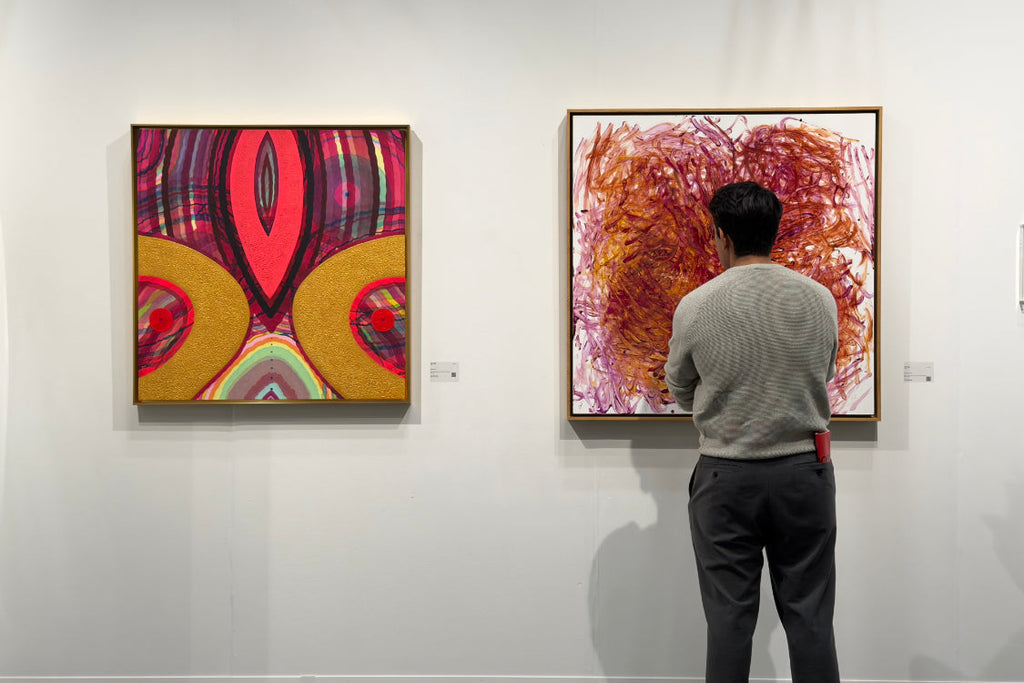
The Armory Show 2026: A Vibrant Showcase of International Art
2026.10.02
REPORT -
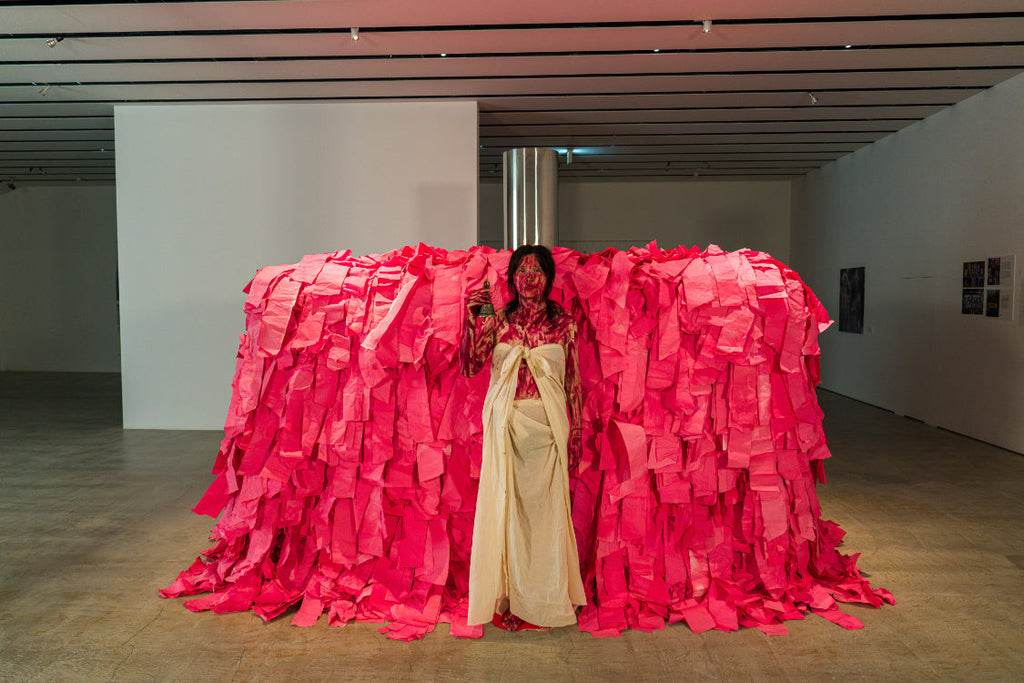
A Soul's Cry Shakes the Museum: A Report on Dai Ying's Live Performance
2026.08.27
REPORT -
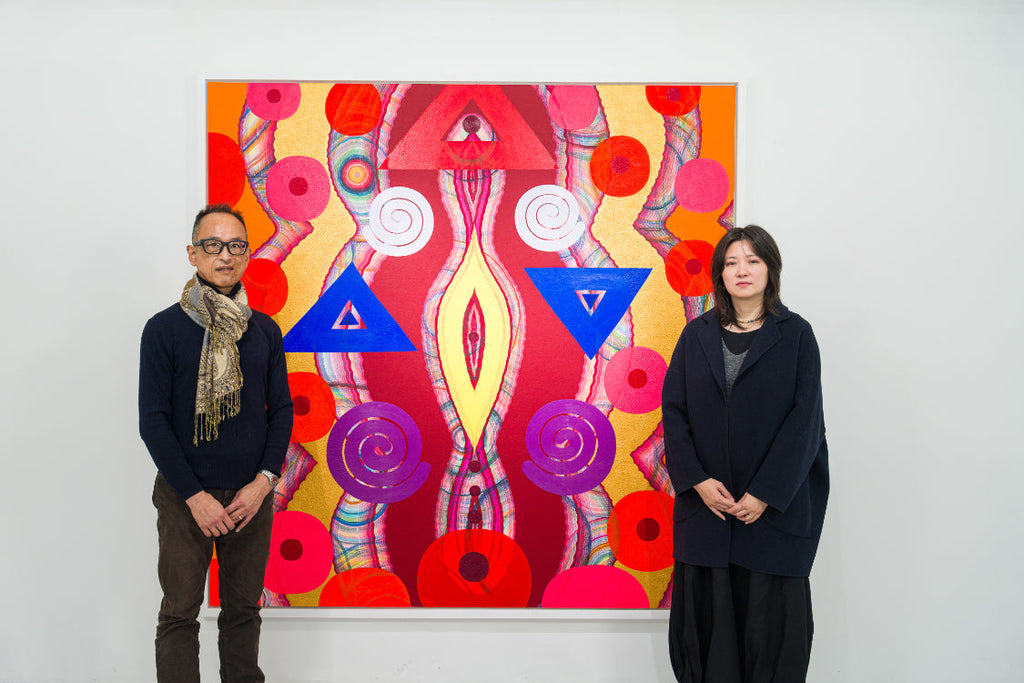
Dai Ying × Meiji Hijikata|Following the Path of Pioneers, Expanding Deeper into the Inner Universe
2026.03.30
INTERVIEW -
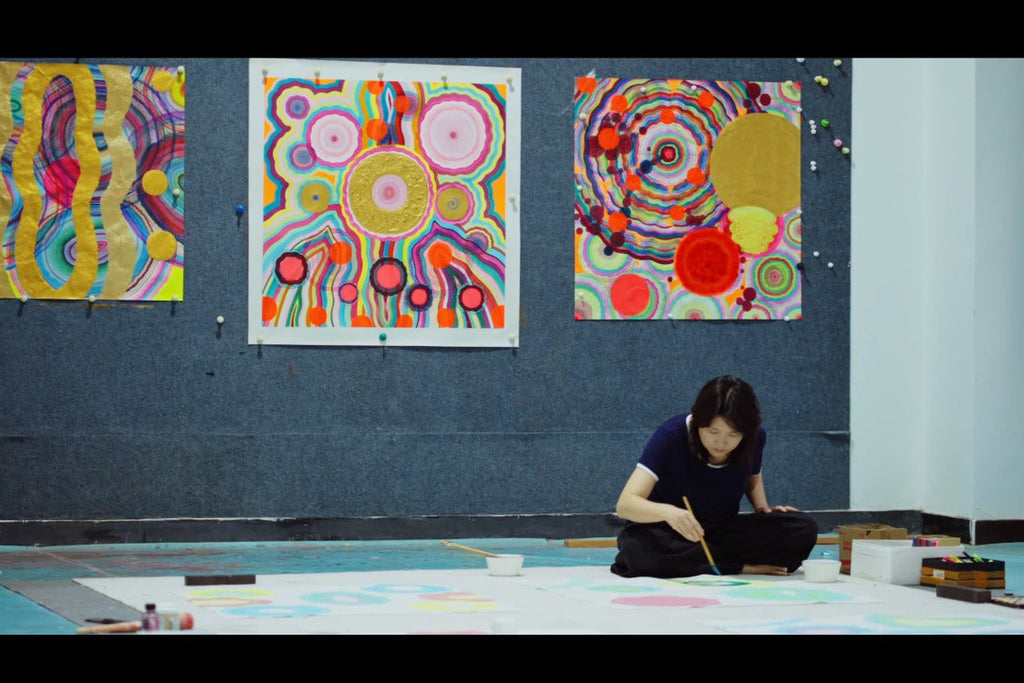
Breathing Lines and Circulating Energy: An interview with Dai Ying
2026.02.18
INTERVIEW
ARTICLES CATEGORY

