
ARTICLES
Tadaaki Kuwayama: If "Nothingness" Has a Shape, Perhaps It Is the Instant of "Art"
2025.10.06
INTERVIEW

This interview was published by Art-Ba-Ba. Please refer to its content.
If one were to record each fleeting afterimage from a fixed gaze and attempt to reassemble a true “color” by collecting such impressions from multiple angles, it would ultimately lead to a conclusion: the human mind can never attain omniscience. And yet, this may be the closest one can come to encountering the shape of nothingness—if every vantage point is “wrong” or “incomplete,” then it is equally “right” and “true.”
Written by / Han Zipei
Edited by / Art-Ba-Ba
Images by / Whitestone Gallery & Artist
In 1966, the Solomon R. Guggenheim Museum in New York held an exhibition titled Systemic Painting. Curated by the institution’s then senior curator and art critic Lawrence Alloway, the exhibition brought together works by 28 artists and focused on the emerging trends within American abstract painting at the time. In the exhibition preface, Alloway noted that a category of geometric abstract painting was gradually entering public awareness. These works, characterized by simplicity, stylization, and meticulously calculated composition, formed a shared “system” exploring the potential of repetition and pattern. This “system” displayed a remarkable diversity and flexibility, encompassing Kenneth Noland’s color field paintings, Frank Stella’s frequent use of shaped canvases, as well as the early minimalist works of Jo Baer and Agnes Martin.

Curator Lawrence Alloway at the installation of “Systemic Painting” exhibition

The cover of the “Systemic Painting” exhibition catalog
It is worth noting that the exhibition catalog included personal statements from the participating artists. Many of these artists, already gaining recognition at the time, used written texts to articulate their in-depth explorations of issues related to painting. Some even adopted a prose-poetry style to express their reflections on the current state of painting and aesthetics. Among these, the briefest—and perhaps the most striking—statement came from Japanese artist Tadaaki Kuwayama. His words spanned just three lines: “Ideas, concepts, philosophy, reasons, meanings, even the humanity of the artist—none of these are present in my work. In my work, there is only art itself. That is all.”

Inside page of the "Systemic Painting" exhibition catalogue (The work on the right side of the image is by Tadaaki Kuwayama)

Tadaaki Kuwayama (1932–2023)
Tadaaki Kuwayama’s first solo exhibition in China, The Shape of Nothingness, is currently on view at Whitestone Gallery Beijing. The exhibition features Kuwayama’s 23 works created between 1961 and 2018, providing a retrospective glimpse into the artist’s creative trajectory. Kuwayama’s artistic journey, as presented in this exhibition, fulfills the pursuit he declared nearly sixty years ago—a relentless dedication to art. With an almost obsessive neutrality, he rejects composition, color, narrative, hierarchy, and subjectivity, instead embarking on a continual exploration of materials, space, and perception. His aim is to open up a purely spiritual experience for the viewer.


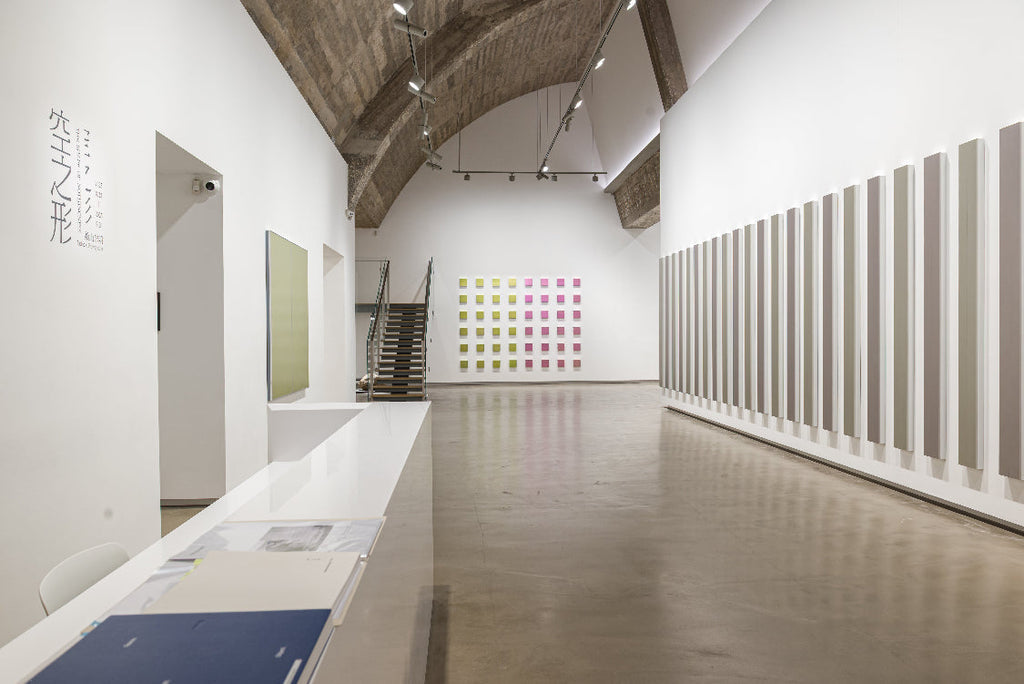
Tadaaki Kuwayama, The Shape of Nothingness, Installation View, Whitestone Gallery Beijing, August 23 – September 20, 2025, Image courtesy of the artist and Whitestone
During his university years, Kuwayama studied Nihonga (Japanese painting) at the Tokyo University of the Arts. However, the institution’s strict academic system made him feel deeply constrained. At the time, students who created abstract paintings or exhibited their works outside the school faced the risk of expulsion. Seeking a more liberated creative environment, Kuwayama moved to New York in 1958. There, he was exposed for the first time to highly expressive art forms such as ‘Action Painting’, whose spontaneous brushwork stood in sharp contrast to the rigorous formal and technical discipline required in Nihonga.

Tadaaki Kuwayama in his New York studio, filmed in 1967

Tadaaki Kuwayama (left) with Frank Stella (right)
Although Kuwayama's decision to move to New York stemmed from his resistance to the limitations of traditional Nihonga and the rigid academic system, he did not adopt a highly expressive or author-centered artistic language. Instead, he began his experimental exploration of painting with materials he was already familiar with. In two works from 1961 (TK7847-61 and TK8048-61), Kuwayama employed traditional Nihonga materials such as dry mineral pigments, silver leaf, and ‘washi’ (traditional Japanese paper) to divide the canvas into distinct zones, each defined by a different material 'territory'. A dripping method allowed the pigments to move across the surface, forming downward-flowing lines that introduced randomness and cross-boundary fusion between materials. This act of surrendering the painterly gesture to external forces like gravity marked his early efforts to reject subjectivity and narrative, signaling the beginning of his negation of painterliness.

Left: Tadaaki Kuwayama, TK7847-61, 1961, 120 × 77 cm, Dry pigment with silver and aluminium leaf on canvas
Right: Tadaaki Kuwayama, TK8048-61, 1961, 121 × 75 cm, Dry pigment and silver leaf on paper on canvas
In TK3924-62, created in 1962, Kuwayama’s direction becomes even more explicit and figurative. The application of pure white acrylic paint causes the work to nearly merge into the wall. Upon closer inspection, densely layered strips of washi form a tightly woven structure. This visual texture suggests that painting itself has been ‘mummified’: all traces of image, color, and even time have been thoroughly sealed away. This conceptual approach would continue to evolve throughout Kuwayama’s later career.

Tadaaki Kuwayama, TK3924-62, 1962, 66 × 66 cm, Acrylic and tape on wood panel, Image courtesy of the artist and Whitestone Gallery

Tadaaki Kuwayama, “The Shape of Nothingness” Installation View, Whitestone Gallery Beijing, August 23 – September 20, 2025, Image courtesy of the artist and Whitestone Gallery
If Ad Reinhardt's ‘Black Paintings’ could be seen as a “requiem” for painting, then what Kuwayama sealed beneath layers of washi was the “rebirth” of the art he longed for. In fact, while the 1966 exhibition Systemic Painting has been regarded as a milestone in the history of painting, with curator Lawrence Alloway attempting to establish a connection between the then-dominant Abstract Expressionism and what he termed “systemic” approaches, Kuwayama’s goal had always been to create what he considered ‘pure art’ — something emerging solely from within himself, detached from historical lineage. In his view, being categorized as a ‘minimalist artist’ was nothing more than a label imposed by theorists. With this in mind, his famously concise artist statement — and his seeming indifference toward prevailing discourses in painting — becomes much easier to understand.

Tadaaki Kuwayama, “The Shape of Nothingness” Installation View, Whitestone Gallery Beijing, August 23 – September 20, 2025, Image courtesy of the artist and Whitestone Gallery
In the subsequent stage of Kuwayama’s practice, the metallic elements that had previously occupied only the edges of his compositions began to infiltrate the entire surface in a more subtle manner— as part of the “pigment” itself. Metallic spray paint gradually emerged as his primary medium. The fluidity and latent gestural trace seen in his earlier works gave way to the precise, industrial homogeneity and cool detachment that defined his later canvases — works such as Untitled (Metallic colors beige) (1973) and Untitled (TK2966) (1978) exemplify this shift.

Tadaaki Kuwayama, “The Shape of Nothingness” Installation View, Whitestone Gallery Beijing, August 23 – September 20, 2025, Image courtesy of the artist and Whitestone Gallery

Tadaaki Kuwayama, Untitled (Metallic colors beige), 1973, 39.8 × 113.3 × 4.3 cm, Metallic paint on canvas and board with aluminium strip, Image courtesy of the artist and Whitestone Gallery
Perhaps, by this point, Kuwayama’s detachment from the subjectivity of painting had already transformed into a presentation of “materiality” itself—bringing him one step closer to the “purity” he envisioned. Throughout the 1960s and 70s, his work primarily consisted of square or rectangular compositions made up of evenly divided, monochromatic blocks. Rather than “dividing” a single canvas, Kuwayama physically assembled multiple panels, joining them together and securing both the seams and outer edges with aluminum strips. He once stated that by replacing painted lines with seams, he was able to eliminate the notion of “composition” altogether.

Tadaaki Kuwayama, TK10260-68, 1968, 152 × 79.4 cm, Acrylic on canvas with aluminium strip, Image courtesy of the artist and Whitestone Gallery
In 1961, Tadaaki Kuwayama held his first solo exhibition at Green Gallery. Around the same period in the early 1960s, another artist closely associated with Kuwayama—Donald Judd, who would later become widely recognized as a leading figure of Minimalism—also exhibited at Green Gallery. Judd had his solo show there in 1963, and the two often encountered each other at the gallery and exchanged ideas. Notably, before fully embracing his identity as an artist, Judd was also the first to write a critical essay on Kuwayama’s work. In terms of artistic language, Judd’s response to the constraints of the rectangular canvas involved an expanded investigation into the relationship between physical objects and space. In contrast, Kuwayama’s hallmark approach of modularly assembling multiple canvases began to blur the boundaries of the medium itself. Each small canvas became the “minimal unit” of the overall composition. These grid-like modules, with their sculptural quality, contained the latent potential to extend across entire walls.
In the two works TK6715-89 and TK5318-5-1/2 created in 1989, the laminated wooden panels reached a thickness of 14 centimeters. Although this extension from the pictorial plane into external space bears resemblance to Donald Judd’s treatment of objecthood, Kuwayama’s works—just as he exerted precise control over the pictorial surface — never trespass into presence within space aggressively. Instead, they “linger quietly” into space, subtly permeating the viewer’s post-exhibition mood with a sense of diffuse resonance.

Tadaaki Kuwayama, “The Shape of Nothingness” Installation View, Whitestone Gallery Beijing, August 23 – September 20, 2025, Image courtesy of the artist and Whitestone Gallery

Tadaaki Kuwayama, TK6715-89, 1989, 33 × 14 × 38 cm, Oil, wax and paper on wood panel, Image courtesy of the artist and Whitestone Gallery
Perhaps influenced by his two daughters, both architects, Kuwayama’s artistic language during this stage was increasingly dominated by the relationship between his works, architectural space, and the viewer’s body. Thin metallic strips were arranged at equal intervals (Untitled (TK 194), 1996), expanding beyond the boundaries of a single wall. These works employed L-shaped or U-shaped spatial compositions that physically enclosed the viewer. The irregular reflectivity of the metallic paint caused the perceived depth and tone of color to shift dramatically based on the viewer’s position, introducing a dynamic interplay between body and perception.


Tadaaki Kuwayama, “The Shape of Nothingness” Installation View, Whitestone Gallery Beijing, August 23 – September 20, 2025, Image courtesy of the artist and Whitestone Gallery

Tadaaki Kuwayama, Untitled (TK194) (detail), 1996, 240 × 17.8 cm (each), Metallic paint on Bakelite board with aluminium bracket, a total of 30 pieces
In his seminal treatise Kitab al-Manazir (Book of Optics), the Arab scientist Ibn al-Haytham pioneered the ‘intromission theory of vision’ based on experimental reasoning, arguing that sight is produced when light enters the eyes. Although this theory of vision has since been widely accepted by modern science, it was preceded by another explanation of visual perception that once gained favor among many philosophers, including Plato. The ‘extramission theory of vision’ posits that the act of seeing occurs when rays of light are emitted from the eyes, pass through the air, and interact with objects, enabling us to perceive their shape, size, and color.
In TK17-7/8-12 (2012), anodized titanium was cut into small pieces and arranged in a matrix formation to cover the entire wall surface. As viewers move through the exhibition space, these seemingly uniform-colored metallic blocks reveal an infinite array of optical shifts in the blink of an eye. This ever-shifting, elusive play of color challenges the viewer’s trust in objective scientific theories of light and color, evoking instead a kind of subjective, mystical sensibility. If one were to record each fleeting afterimage from a fixed gaze and attempt to reassemble a true “color” by collecting such impressions from multiple angles, it would ultimately lead to a conclusion: the human mind can never attain omniscience. And yet, this may be the closest one can come to encountering The Shape of Nothingness—if every vantage point is “wrong” or “incomplete,” then it is equally “right” and “true.”


Tadaaki Kuwayama, “The Shape of Nothingness” Installation View, Whitestone Gallery Beijing, August 23 – September 20, 2025, Image courtesy of the artist and Whitestone Gallery

Tadaaki Kuwayama, TK17-7/8-12 (detail), 2012, Anodized titanium, 19.8 × 19.8 × 5.1 cm (each), a total of 48 pieces, Image courtesy of the artist and Whitestone Gallery
The most expressive aspect of Tadaaki Kuwayama’s practice lies in his unwavering pursuit of what he envisioned as “art” itself. The meaning of the work, the purpose of creation, and its impact on the audience—all of these were excluded from the realm of pure art that Kuwayama aspired to. Unlike many artists who produce bodies of work in a chronological series, Kuwayama’s different types of works recur cyclically throughout his career. This wholeness in his practice eliminates any sense of “progress” or hierarchy among the works, aligning with his pursuit of an art that is “ahistorical.” While his paintings share many visual elements and materials with Minimalist art, for Kuwayama, materials were merely tools for cultivating a sense of nothingness and purity. True art did not reside in the artist’s mind, nor in any specific object. It was something that could be felt only in the fleeting moment of its manifestation.


Tadaaki Kuwayama, “The Shape of Nothingness” Installation View, Whitestone Gallery Beijing, August 23 – September 20, 2025, Image courtesy of the artist and Whitestone Gallery
ARTIST
RELATED ARTICLES
-
Financial Times Chinese Report | A Conversation with Yukio Shiraishi: Art Knows No Borders
2025.11.05
INTERVIEW -

Echoes of Silence: Tadaaki Kuwayama & Rakuko Naito's Minimalist Exploration
2024.02.09
FEATURE -

Life in New York as an Artist: Harmony of Art, People, and Space
A New Appreciation Contemporary Japanese and Asian Art
23/23 -

Discovering the Essence of Art: Renowned American Artist, Tadaaki Kuwayama
A New Appreciation Contemporary Japanese and Asian Art
22/23


ARTICLES CATEGORY

