
ARTICLES
Karen Shiozawa Wondrous by Art Practitioner
2026.02.05
INTERVIEW

This interview was published by Art Practitioner. Please refer to its content.
Interviewer: Guo Ai – Chief Editor
Ai: Let me begin by sharing a possible direction for our conversation today. I read the curatorial text you wrote, and there were some very emotional lines that really moved me. So I’d like to start from those more sensorial, language-based parts—talking about your experiences and stories. And when we reach the point where the stories feel “used up,” we can follow that thread into the works. That’s roughly the approach I have in mind.
SectionⅠ: About the word “Ticket”
Karen Shiozawa: As I wrote in my text, “I must never lose that ticket that can take me there at any time.” Not only the works in this exhibition, but in fact all of my works share one central question: “For people, what is a precious memory?” Perhaps it is the feeling of longing itself. Things like scenery and memories may not be necessities of life, but they are indispensable—something that supports us in living. They are an essential landscape in one’s life.
So… why did I choose the word “ticket,” which leaves such a strong impression? I imagine many people would ask that. When the concept for this exhibition first began to take shape, I happened to be reading the work of novelist Kenji Miyazawa. I’m not sure how well-known he is in China, but he is certainly quite famous. His best-known work is probably the novel Night on the Galactic Railroad. Near the end of that story, there is a line that says, “You must never lose that one true ticket—the only genuine ticket—in the Milky Way.” I felt that idea resonated deeply with my own creative philosophy, so I borrowed the line. The key visual work for this exhibition is titled Galaxy Express—and that title is, in essence, “the Galactic Railroad.”
SectionⅡ: About Night on the Ggaractic Railroad
Ai: What is Night on the Galactic Railroad about?
Shiozawa: Sure—I’ll explain briefly. I think this work is one of the most internationally recognized works of Japanese literature. In the story, there is a boy protagonist who has a very close friend named Campanella. One night, Campanella suddenly disappears, and the protagonist, Giovanni, boards a train to search for him—only to discover in the end that Campanella had actually died that same night. It is a story about a boy searching for his lost best friend, setting off on a journey aboard a train through the Milky Way.
As the train travels, Giovanni encounters all kinds of people and events, and he begins to think about what happiness in life truly is, and what the essence of joy might be. By the end, Giovanni even wants to come back together with his best friend, but he cannot… So it is a story that reflects on what truly matters within a short human life.
Interpreter’s note: Does the protagonist want to go to where his friend is?
Shiozawa: Yes—this is the story that he goes to look for his friend. There is also a background in the story: that night, there is a special festival in town. On the very night of the festival, his best friend disappears, and Giovanni keeps thinking, “Where did he go?” At that moment, he boards that train—the Galactic Railroad—which appears only on that special night. The train travels through the galaxy, and so a long journey begins.
Along the way, Giovanni meets all kinds of passengers—people from different countries, with different professions. In the process of searching for his friend while also meeting others, he begins to pursue the question: “What is happiness in life?” That’s the basic outline.
SectionⅢ: Relationship between the novel and myself
Ai: How is the story in this novel connected to you at this stage of your life—or rather, how did your relationship with this novel begin? And once that relationship was established, why do you feel it belongs to everyone today, that it has a universal quality? I want to know: is this body of work a reenactment of the novel’s relationship and plot? In these works, what position do you place yourself in? Are you recreating the story from an all-knowing, godlike perspective—or are you also a character within it?
Shiozawa: Okay. There are quite a few questions, so I’ll answer them one by one.
First, regarding my relationship with the novel: the sources of inspiration for my work are not limited to this novel. Sometimes I draw from my own memories and experiences. Sometimes I work with large-scale spatial themes—stars, the moon, the universe. I’ve made quite a few works along those lines. I often think about things that go beyond everyday reality—myths, ancient legends, difficult-to-explain phenomena, and so on.
As for Night on the Galactic Railroad, in Japan it is almost universally known—people even study it in school textbooks. I have always wondered: why do so many people resonate with this work? If so, many people are moved by it, it must hold meaning. So, this exhibition is not a simple adaptation of the novel. Rather, it is my own response, based on how I understand Kenji Miyazawa’s work. I want to present the thoughts I have now, through this exhibition.
What Kenji Miyazawa tries to convey—questions like “What personal happiness is?”, or “What it means to share happiness with others?”—can lead people into thinking about life. I think this is the universal theme for everyone.

Detail of work by Karen Shiozawa ©Whitestone Gallery
As for my stance within the works: in my work, “girls” often appear, as well as living creatures that inhabit that world. These figures are inspired by classic stories, and in a certain sense they are also me placing myself into that world. I have always created with a feeling of “coexisting with the world of my works.” To share my experiences and memories through the work, in the same space with the audience—that itself feels meaningful to me.
This time, I intentionally stepped away from my previous, more personal mode of creation and chose a story that many people already know, because I wanted to share memory and experience with others on a broader level. I hope this is not only my private world, but also a doorway for the audience’s thinking. I am not looking down from a “godlike” position; rather, I also enter the world of my works. The girls and creatures in the works are, in a sense, also myself. I believe that sharing memory and experience holds important meaning.
SectionⅣ: the feeling awakened by the word “Ticket”
Ai: Beyond the novel’s status and fame, you also mentioned meaning, feelings, and personal connections just now. What exactly are those?
When I read “I must never lose the ticket that allows me to go there at any time,” as a Chinese person born in the 1990s, the only very concrete thing I can grasp is “a ticket.” And yet the line strongly conveys a feeling I associate with works from Japanese culture I’ve encountered in my imagination and during my growth. So I want to confirm: what exactly are the meanings, feelings, and connections you mentioned?
Interpreter’s note: The feeling she got from the novel?
Ai: Yes—not necessarily only from the novel, but also from the group of works in this exhibition. Because I hear you talk about many meanings and connections, but not yet concretely what they are. The feeling I get from your answer is similar to the feeling I got from that line: I can sense an emotion, but what is it exactly? I need to confirm it—because right now I’m mostly guessing based on my own past experiences.
Shiozawa: When I think about why Kenji Miyazawa wrote the line, and combine it with my own experience of making work, I feel what he wanted to convey is extremely close to what I have always wanted to communicate through my work: namely, “What is the true happiness in life that we must never lose?”
The novel itself also weaves in Kenji Miyazawa’s own memories and experiences—memories related to a close friend, moments of loneliness, and fragments of happiness. I feel these are experiences everyone encounters in life—precious time, and loneliness as well. The novel also explores how we might cross over such difficulties.
When I think of that line— “You must never lose this ticket”—the strongest feeling I have is: if we can explore our happiest memories, question the meaning of those memories, and then share that feeling with others, it could bring different kinds of discoveries—for ourselves and for others.
SectionⅤ: the word “the moon” that awaken memory
Ai: You mentioned you hope this exhibition can awaken memories. What specific things did you use to awaken memory?
For example, “a ticket”—in Japan, maybe people still use physical tickets, but in China, people don’t really have a physical sense of “tickets” anymore. It’s all digital. And yet, when you see that word in a text, it has a kind of magic: it can trigger memories or experiences. So, in this series—whether through that line or through the works—what kinds of “channels” or “entry points” did you set up to awaken people’s memories?
Shiozawa: First, the word “ticket” itself has strong symbolic meaning. And another core theme of this exhibition is “the moon.” The exhibition title intentionally uses the concrete phrase Once Upon a Time - Tales of Moon.

Entrance to Karen Shiozawa's Solo Exhibition "Once Upon a Time ‒ Tales of Moon ‒"
I have always loved the image of the moon; it appears frequently in my past works as well. When I decided to hold an exhibition in China, I thought: what kind of image could best become an entry point for viewers into a wondrous, fantastical world? And I thought of the moon.
In China, the moon motif is widely known as a gateway to a mysterious world, much like the association of rabbits and the moon, I believe. That is why, in this exhibition, I intentionally incorporated the moon into every work—hoping it can function as a trigger point, as you said, to awaken imagination.
SectionⅥ: About the moon and personal memory
AI: In your understanding, what do you think the moon evokes as a shared feeling among people around the world? And personally for you, what special relationship do you have with the moon? What memories does it awaken for you?
Shiozawa: In previous exhibitions, my focus expanded from childhood memories and the grand landscape I experienced as a child to the mysterious phenomena that defy description, extending from that same perspective. So, the moon feels very mysterious to me.
The moon is something we can see every day in ordinary life, but the images and emotions that arise when each person sees the moon are different. Through the moon in this exhibition, I want to see what viewers will associate with it. For me, it is also a kind of “question.”
But if one day the moon suddenly disappeared from the sky, I think everyone would feel deeply unsettled. It is an image that is mysterious, and yet it makes people feel at ease. I find that contrast fascinating, and it is why I became so interested in the moon.
SectionⅦ: About the moon and personal memory
Ai: I heard something interesting just now: you want to paint with “the moon” as a theme, and then see what your paintings awaken in yourself. Could you share your creative method? When you begin a new series—whether content-wise or in terms of entering a new stage of visual language—how does it begin?
For example, some artists work in a very planned way: if they’re making a “moon series,” they already know what the series will look like. Others begin more accidentally: they paint one moon-related work, then realize they’re drawn to the moon, and want to paint a second, a third, and so on. Which way are you closer to?
Shiozawa: You’re asking about my creative mode, right? I chose the moon as a very specific theme this time because I’ve always liked astronomical themes—stars, the universe, and so on.
I also love researching wondrous stories, legends from various places, and important customs. I feel that things passed down from generation to generation must be very important—spiritual supports that help people live. My practice has long revolved around asking, “Why do these things exist?”
I’ve also created many paintings and drawings about the moon. So rather than a completely new attempt, this series is more like further focusing and narrowing the scope based on my previous thinking. Because the exhibition is in China, I wanted to create an exhibition that could only be seen in this specific context—that was the original motivation.
Interpreter’s note: So you’re the type who plans first and then creates, right?
Shiozawa: In a sense, yes—but more precisely, many of the works in this exhibition, whether drawings or other types, were selected from a long accumulation of sketches and materials, or from earlier works that were previously unpublished. So rather than being created specifically for this exhibition, it is more like a collection that gradually crystallized through daily practice.
SectionⅧ: Most concerns throughout the entire practice
Ai: If we look beyond this exhibition and consider your entire practice, what concerns you most? The things you mentioned—stars, the moon, plants—are you concerned with them in a very concrete way, or is it more an interest in mysticism and symbols?
Shiozawa: It’s true that the moon appears frequently in my work, but my creation originally began from personal experience and childhood memory. Real experiences like those are the starting point of my work—and still are.
As for why I intentionally used images like “the galaxy, stars, and the moon” this time, there is another reason. In your interview outline, you asked an interesting question: whether there is a work that could symbolize a connection among Japan, China, and the Netherlands.
Actually, the word “galaxy” in Night on the Galactic Railroad—speaking of it—was not originally a Japanese word; its roots trace back to the Chinese “Yellow River (Huánghé)”, Kenji Miyazawa also loved this term, and I think it is a very beautiful word.

Detail of work by Karen Shiozawa ©Whitestone Gallery
My way of thinking in the work may carry a strong Japanese sensibility, but by incorporating “galaxy,” which has roots in Chinese, and by combining it with my understanding of stars—which is also influenced by Western astronomy—you could say this body of work blends cultural elements from multiple countries. This is a way of working I’ve always wanted to try.
So for me this was a new challenge: to step outside the framework of personal memory, and through stories and images familiar to many people, create resonance with a wider audience.
The meaning of holding this exhibition is very important to me. In the past, my work often stayed within my own memory—more personal. I used to think that was fine. But later I realized that if I want to address more universal themes, and share the same “time” with more people, the creation that completes in only personal memory and experience is not enough. So this exhibition feels like breaking the boundaries of my past practice and moving into a new stage.
SectionⅨ: Empathy beyond in languages
Ai: Why is breaking regional or geographic boundaries important to you? I’m not saying it isn’t important—rather, because you made this choice, I want to understand it. You have ever lived in the Netherlands, but you are Japanese.
Why does the difference between regions matter so much in creation? Some people live between cultures, but what they express doesn’t necessarily begin from that. But I can tell it matters to you.
Shiozawa: I don’t think I create to “break boundaries.” Although I am Japanese, I spent a long time living overseas as a child. At that time, I often faced situations where I couldn’t communicate because of language barriers. But even so, I still wanted to connect with others, to communicate. In that process, drawing naturally became my way of communication.
I believe that between people there is always an emotional resonance that can cross language—longing for one’s hometown, curiosity toward the unknown, confusion caused by misunderstanding… These emotions are shared.
SectionⅩ: About the film “Lost in Translation”
Ai: You probably know the famous film Lost in Translation. I want to ask, as a Japanese person, how do you view a story like that being told from a Western perspective? These kinds of stories can happen in Tokyo, but we rarely see similar stories told by Westerners happening in, say, China—where language is also not shared. Why do such stories “happen” in Japan?
Shiozawa: Speaking from my personal feeling, Japanese people tend to know relatively little about other cultures and knowledge—though I know this is subjective. In Japan, many people admire other countries, but hesitate to take the step to truly learn about them. I think that may be one reason why films and works about foreign places are popular in Japan.
Japanese is also a relatively small language, and Japan is a relatively small country. But I believe people are very curious about the wider world and want to see more different stories. So some stories are set in Japan.
Your question also makes me think of something beyond film: in Japan, many TV variety shows and reality programs—where foreigners come to Japan and experience Japanese culture—are extremely popular. I’ve often wondered why. Maybe when people face a foreign country or an unfamiliar existence, if they can find resonance, they feel very happy. Even a simple shared emotion like “this food is delicious” can instantly bring people closer.
Many films end with a happy resolution—stories of mutual understanding and forming bonds. I think such stories work because no matter how different the country, culture, language, or ways of thinking may be, there must be something people can understand in common.
I hope my work can be like that too. Even if a viewer thinks, “This is completely different from what I know,” if they can associate it with a landscape from their own memory, or feel “I’ve felt something like this too,” and it sparks some exchange—then that is what I most hope to see. I also really want to know why people can resonate so strongly even when language is not shared.
SectionⅪ: About “inexblicable” and “wondrous”
Ai: Great. I have two last small questions. First, you used the word “inexplicable” (or “wondrous”) a lot just now. How is that “inexplicable” quality achieved? What is the recipe for it?
When I came in, I took a quick look at the works. They don’t seem to simply depict myths, fairy tales, or reality. So “inexplicable” feels like a more accurate word. Since you keep using it, I want to know: what is the recipe—what composes that “inexplicable” quality?
Shiozawa: I know some artists design specific techniques in order to achieve certain effects or convey certain emotions. But I’m different. In my mind, images and landscapes naturally arise. I don’t deliberately plan them; they emerge instinctively, spontaneously. I simply present those images as they appear—there isn’t a deliberately constructed process or plan.
So those images are… hard to put into words. They start as something vague, and gradually become clearer.
Many of my earlier works were based on such personal memory and experience, so they may not have been easy for audiences to understand. But as my practice accumulated, I began to understand more and more about those inspirations I cannot control.
I’m not creating in a forced way; rather, I’m letting those vague landscapes become clearer within the work. So rather than a “recipe,” I would say the “inexplicable” quality naturally flows through my work.
SectionⅫ: closing eyes to call up certain images
Ai: The last question might be a bit sensitive—I’m not sure if it’s appropriate. I noticed that when you speak, you sometimes close your eyes. Recently I talked with another artist who said that when he can’t see—like right after waking up or while showering—closing his eyes can evoke more “truth.” Is closing your eyes simply a habit when you speak? Have you noticed it? Are you calling up certain images or visuals?
Shiozawa: It’s totally fine! People have asked me that before. I do feel that sometimes I like to speak with my eyes closed—though perhaps in a different way from the friend you mentioned. For me, when I close my eyes, my imagination becomes richer and certain scenes can appear more easily. Especially when speaking, it also helps me remember what I’m talking about more clearly.

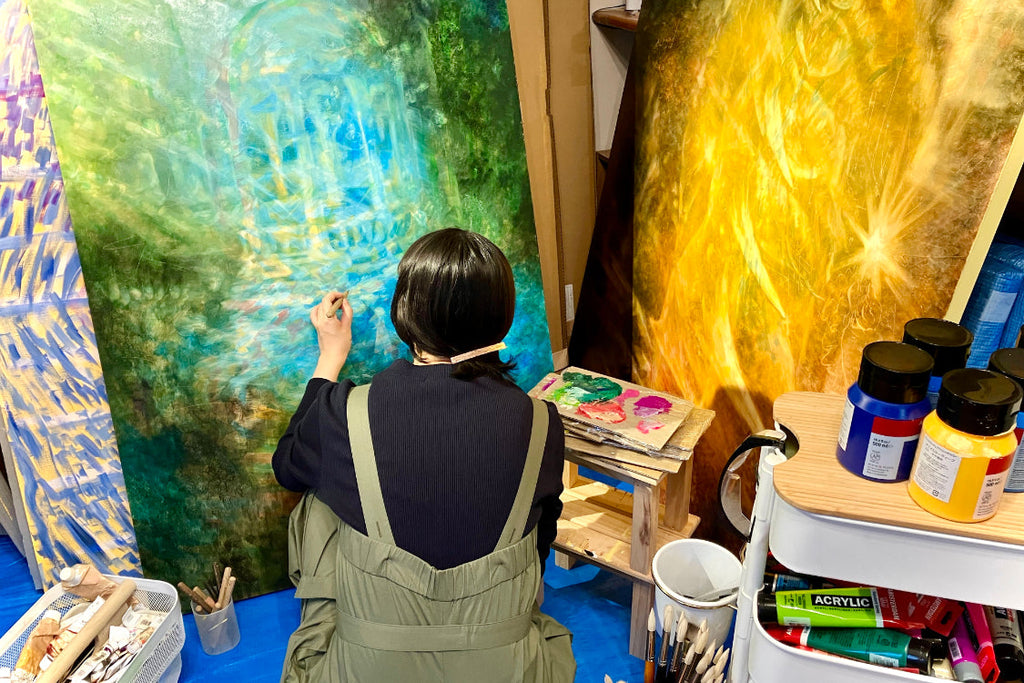
Artist Karen Shiozawa at the exhibition view © Karen Shiozawa Studio and Whitestone Gallery
Sometimes when I close my eyes, many images suddenly appear, and I quickly record them. But these records don’t necessarily become works directly. There are countless unformed images in those notes—so many that when I look back later, I sometimes wonder, “What is this?”
My painting process is really the process of making those vague images become clear, little by little. That also connects to your previous question “inexplicable”. Many artists make sketches first and then proceed step by step, but my process is different. For me, the panel and paint are tools to make the images in my mind clearer.
So I don’t deliberately decide where to use which color. Instead, I layer paint again and again. Sometimes I even cover the entire surface with black, as if tracing the images in my mind. In that process, I search for the original image that first appeared. At some point, I suddenly feel, “Ah—this is the landscape I want to paint.” Then, while keeping that image clear, I bring it fully into the work. I repeat that process.
So yes—I often close my eyes when imagining those landscapes, and perhaps that’s why the way I speak can become a bit vague too. (Laughs)
Ai: Shall we go into the gallery and pick two works to share and talk through? Two should be enough.
SectionXIII: closing eyes to call up certain images
(They walk into the exhibition space.)

“Once Upon a Time ‒ Tales of Moon ‒” 2025, 162.0 × 194.0 cm, Oil, acrylic, and synthetic resin on wood panel © Karen Shiozawa Studio and Whitestone Gallery
Shiozawa: This work is the main piece of this exhibition. It shares the same theme and title as the exhibition: “Once upon a time - tales of moon” (and we simplify it as Once Upon a Time - Tales of Moon / 昔时月语). This work was created especially for this exhibition.
As we mentioned earlier, in many myths and legends, the moon plays the role of an “entry point” into the world of stories. In this work, there is also a train. You see a road extending into the distance, and a moon. The light projected from afar seems to suggest that a story is about to unfold. One side of the painting is bluish, a quiet world; on the other side, colored light seems to seep in.
The base is mostly blue. Blue represents our reality. And that light represents something unknown—a premonition that something is about to happen.
There is another distinctive element here: in the background, there are structures that look like towers of light, or like mountain ranges. These repeated architectural motifs are elements that often appear in my work. The inspiration comes from a place where I lived as a child in the Netherlands: Kinderdijk.
There are wide rivers there, and rows of windmills. That scenery is one of the deepest images in my childhood memory, so tower-like forms often appear in my works.

Detail of work by Karen Shiozawa ©Whitestone Gallery
Ai: These yellows and greens—did you add them at the final stage, or did you plan them from the start? And were you thinking in terms of composition, or is it related to content?
Shiozawa: These colors appear in almost all my works, and they are always added at the very end. They come from the flickering of light. I don’t deliberately design them; they emerge naturally.
I feel that the essence of light is that countless colors gather and ultimately appear as white. But sometimes light flickers and reveals different colors. When I depict light, I naturally leave that wavering, shifting sense of color in the final strokes.
Ai: So when you add those parts, that’s when you consider the work finished? I also notice these small figures appear in many works—are they also related to you, especially this little girl?
Shiozawa: Even without these figures, the world of the painting can stand. But when I create, I always carry a feeling of “standing at the entrance of the painted world.” The figures can be me, but not entirely me. In the painting, they might be traveling more freely than I can.
I paint them very small because I want viewers to imagine how vast the world is through those tiny silhouettes. And actually, from the very beginning—when the composition first appeared—those figures naturally emerged in my mind as well.
Ai: I heard that your underpainting is yellow?

Karen Shiozawa’s creative process © Karen Shiozawa Studio and Whitestone Gallery
Shiozawa: Yes. Basically, for every work, I start with a yellow ground. That is one characteristic of my work. I feel that yellow resembles the color of Dutch light.
Many works begin from that yellow-toned base; I layer many colors, and then cover everything again with dark color oil—almost as if nothing ever happened. Then I gradually scrape back the paint so that the image in my mind slowly appears.
This time, though, it’s a bit different because there are many night scenes and bluish compositions. So sometimes I begin from a bluish base. But most of the time, I adjust the ground color subtly depending on my mood.
Ai: So the blues we see are the base coming through?
Shiozawa: At the beginning, it’s actually a completely blank panel. I can show you—creation starts from a blank board like this.
First I use acrylic paint, and then I paint with oil on top. And all these works are painted directly on wooden panels. I’m not very comfortable painting on stretched wood panel; I prefer a harder surface.
I really want to paint the way you write with a pen on paper, but it’s hard to achieve that feeling with canvas, so I need a firmer support.
Ai: I noticed many scratch-like marks. Do you paint with the panel placed flat under light like this? So it’s on a table rather than on a wall?

Karen Shiozawa’s creative process © Karen Shiozawa Studio and Whitestone Gallery
Shiozawa: For small works, I place them on a table; for large works, I hang them on a wall. I’m not carving the wood panel itself—I’m gently scraping away the surface layers of paint, layer by layer. Then I repeatedly tapping and add lines that look like rays of light, and the process repeats.
The layering of colors becomes more complex each time. Depending on what the work needs, I keep adding or removing colors—again and again.
Ai: When you work on these local areas, if you only look at the local parts, it almost feels like abstract painting.

“Galaxy Express” 2025, 162.0 × 194.0 cm, Oil, acrylic, and synthetic resin on wood panel © Whitestone Gallery
Shiozawa: In the process, I often feel a kind of glow—like light. Different works vary slightly in color, but the overall process is like this.
This work here relates to Night on the Galactic Railroad. You can see the train here… Rather than saying it’s “my work,” I would say it was created out of respect for Kenji Miyazawa. The upper part is that imagined world I described earlier.
The scenery deep in the painting—forms like small mountains, and structures resembling Western architecture—these are elements that often appear in my work. Especially this triangular motif: it comes from a structure in a Dutch amusement park I used to visit as a child—Efteling, something like the Dutch version of Disneyland. That building is one of the most dreamlike symbols in my childhood memory, so I brought it into the painting.
And then there is this aurora-like image. This kind of expression appears in my work several times. It’s a way of depicting light, and the method is also different: first I draw these light lines, and then I add the vivid colors that auroras often have.
I chose this technique this time because I felt it best connects the atmosphere of Night on the Galactic Railroad with the imagined world I wanted to depict. The aurora is fleeting—light and shadow that vanish in an instant—and I felt it suited this kind of story.
Ai: Is this area “made” rather than painted?
Shiozawa: Here I wanted to express a feeling of the imagined, dreamlike world gradually disappearing—colors fading away. To create this effect, the oil paint needs to be in a state where it hasn’t fully dried. Only then can this kind of color be achieved.
Ai: For the installation lighting—does it just illuminate this area and then everything becomes bright?

Karen Shiozawa’s Solo Exhibition "Once Upon a Time ‒ Tales of Moon ‒" at the exhibition view © Whitestone Gallery
Shiozawa: The lighting and installation were arranged according to my request. I wanted to express the feeling of the world in my imagination: it’s very dark outside, and as you enter and keep walking… when you reach here, it starts to brighten—like you’ve arrived in that imagined world.
That’s why these two spotlights are aimed specifically here. The direction—from upper left to lower right—is not an evenly distributed front light. I wanted it to feel like: as you walk here, it begins to grow brighter, and you arrive at that imagined world.
Ai: Great—thank you so much!

ARTIST
RELATED ARTICLES
-
Tracing the Boundary Between the Inner Light and the World: A Dialogue Between Karen Shiozawa and Dr. Shuo Hua
2026.10.15
INTERVIEW -
Karen Shiozawa Selected for Major Exhibition in New York's Times Square
2026.09.18
ART NEWS -
Karen Shiozawa × Meiji Hijikata | Dreamlike Brushstrokes that Evoke Empathy
2024.05.10
INTERVIEW -
Karen Shiozawa × Meiji Hijikata | The Depths of the Heart Projected by a Magical Light
2024.05.07
INTERVIEW
ARTICLES CATEGORY

