
ARTICLES
Inside Yu Kawashima's World of Painted Ink and Mineral Pigments
2025.10.30
INTERVIEW

Artist Yu Kawashima has been depicting the anxieties swirling in contemporary society and the thirst for life, primarily using ink. In his solo exhibition marking a decade milestone, he returns to his roots in "Nihonga" (Japanese painting) and reexamines the essence of expression. We asked about his intentions and techniques in this endeavor where the glamorous surface and shadowy interior resonate with one another.
Restraining Color Until Now

Yu Kawashima《Revelation》2024, 50.0 × 72.7cm, platinum leaf, whiting, mineral pigments, ink on hemp paper
We asked Kawashima, who has recently begun creating works using colors other than monochrome, about what kind of expansion or changes he feels in his artistic expression and creative process.
"Originally, I didn't have the awareness that I was painting in monotone, but rather a stronger awareness that I was 'restraining color.'" He explains that he began using color with "the image of liberating one color at a time within that restraint." Even in his previous works that appeared monochromatic, Kawashima had been painting while sensing the qualities of color, as he discussed in a previous dialogue with Meiji Hijikata, director of the Taro Okamoto Museum of Art. In the current series he represents the same attitude with enhanced visibility.
The criteria for color selection are based on the theme of the work. In this exhibition, he chose warm colors such as red and yellow. While his previous works were monochromatic, many evoked cool colors. He began to feel a need to "expose more of my own passions and emotional aspects close to the soul," and he naturally felt drawn to reach for the colors he sensed within.
Red, one of these colors, can evoke various things related to living, such as the color of the sun or blood. The work "Reactor," created while writing his doctoral dissertation, uses an artificial sun as its motif. Because the sun is "an unknown energy for humanity, something that feels close to God," he created the work with the concept of creating it within himself. Kawashima's creative work that began here connects to his current works, so it may be appearing as the concept of this exhibition.

Yu Kawashima《Citrintas》2025, 91.0 × 91.0cm, mineral pigments, platinum leaf, silver leaf, ink on hemp paper
On the other hand, yellow has an image close to gold for Kawashima. While he originally used cool-toned metallic leaves such as silver and platinum leaf, he now intentionally uses yellowgold, which is contrasting and more assertive, "to draw out different aspects of myself."
The reason for using primary colors comes from his idea that "I hope to convey the beauty of Nihonga materials and direct colors." Rather than intermediate colors through color mixing, he chooses primary natural mineral pigments from the "awareness of using mineral pigments in Nihonga." Additionally, to improve adhesion to the canvas, he mixes mica (kira), a natural mineral pigment composed of reflective flakes. More recently, he has begun experimenting with newly discovered rainbow-like mixed-color mica combined with colors that match his sensibilities. He explores tastes that match his color sensibilities while allowing the strength of primary colors and the delicate brilliance of mixed colors to coexist.
Exploring from Where There Are No Forms

Yu Kawashima “non title(2)” 2025, 33.3 × 24.2cm, mineral pigments, ink on hemp paper
While Kawashima's works are often associated with girl motifs, this exhibition also features abstract paintings. Kawashima had been painting abstract works even before his debut, so we asked about the intention behind this exhibition.
"In the past, I had a series called 'Medicine,' where I gave titles related to the names of substances that affect human emotions. I was painting the formless, hazy things one feels when taking medicine".
His current abstract paintings derive from the "atmosphere" of living in contemporary society. Kawashima describes the atmosphere he feels in Tokyo, where he currently lives, as "not clear, but somehow fitting" — a feeling that keeps him drawn to the city. While figurative paintings have atmospheres that emerge from elements like facial expressions, concrete, and geometric patterns, he attempts to "draw from the emotional places within myself" without relying on these external cues.
Resonance and Duality

Artist in Studio
With two main visuals created for this exhibition, he aimed to “show the front and back,” presenting different facets of his work. Through the contrast between works with glamorous motifs and girl figures hidden in shadows, the duality of the superficial and internal aspects within Kawashima emerges. The way these two pieces resonate with each other connects to the exhibition title "Reflection."
Furthermore, "Reflection" carries two meanings: one is subjective, expressing what the artist feels as well as the process of change from his past self to his current self; the other relates to societal movements.
"In today's society, I strongly feel that when something changes, it influences something else. Like when someone writes something on the internet, someone else sees it and feels something different." Kawashima reflects this sense of chain-like resonance in his works.
Works Are Not Images but Forms

Yu Kawashima《Purify》2025, 91.0 × 61.6cm, mineral pigments, platinum leaf, silver leaf, ink on hemp paper
For Kawashima, individual titles have precise meaning, but the works themselves are “meaningless". This is because they are "not 'images' but 'forms,' and that is what 'painting' is," Kawashima says.
"In today's era, easily understandable things tend to be sought after, but I think artworks are things where expression precedes meaning." The act of creating, along with the resulting effects and expressions, evokes a variety of thoughts in viewers. Forms don't remain just shapes but contain meanings that only the creator understands. For Kawashima, that would be the title.
Declaring works as "meaningless" implies that viewers are free to interpret them as they like.
"If the creator says 'this means this,' that becomes the correct answer and the conversation ends. That would be something design-like, I think. I believe art is about diversity, so I think works that allow various interpretations and ways of viewing create stronger empathy."
Painting "Signs" as an Extension of Realism

Artist being interviewed in his atelier
Kawashima says he has "returned to Nihonga" in this creative activity. "I had the strongest desire to find something new by returning to my origins,". When he started his activities as a painter, his works were accepted as contemporary art in the style of Nihonga, but he says that Nihonga remains the foundation of his practice.
Regarding his position in art history, while Kawashima uses Nihonga as an expression, he states that he "considers himself to be on the extension of realism." He pursuits his own realism that comes after movements like Cubism and Surrealism. With this understanding, he sees himself as a painter who seeks to create paintings that belong to this era.
When asked about his ultimate goal in creating works, Kawashima mentioned "hyōchō" (symbols/emblems). He explains that works become symbols when they transform from images to forms and take on his conceptual meanings. The realm of "symbols" he aims for presents to us the true way of contemporary Nihonga that transcends mere techniques and styles.
Kawashima’s exploration continues. We invite you to experience the shifts and resonances in his work by seeing them in person.
ARTIST
RELATED ARTICLES
-
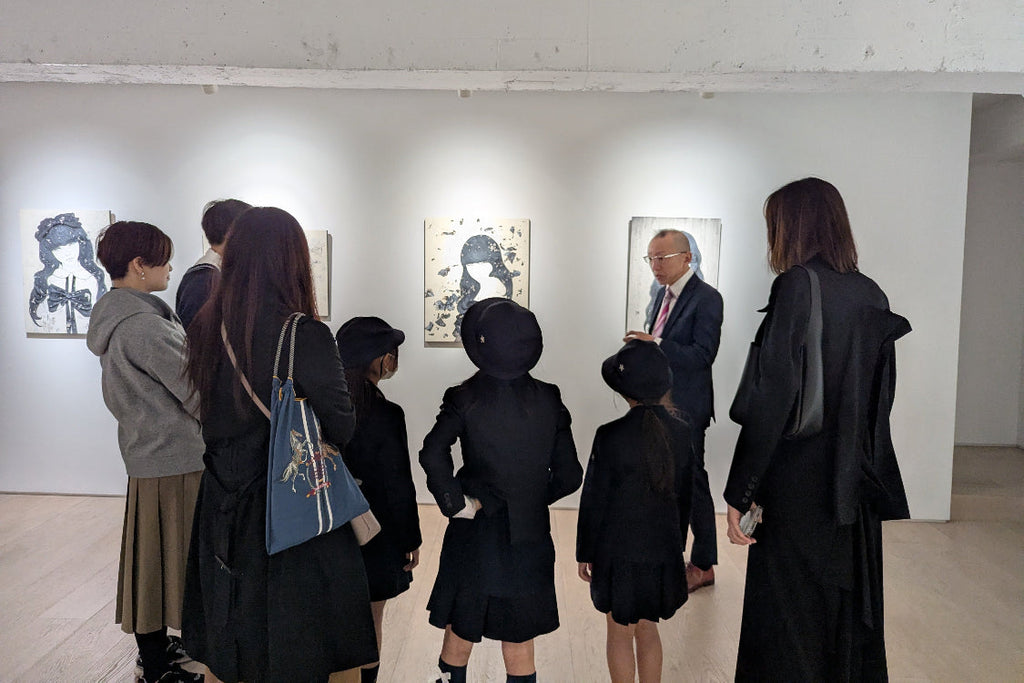
Students from Taimei Elementary School Visit Whitestone Ginza New Gallery
2025.11.14
ART NEWS -

新春特別企劃:三位藝術家詮釋蛇年
2025.01.20
FEATURE -
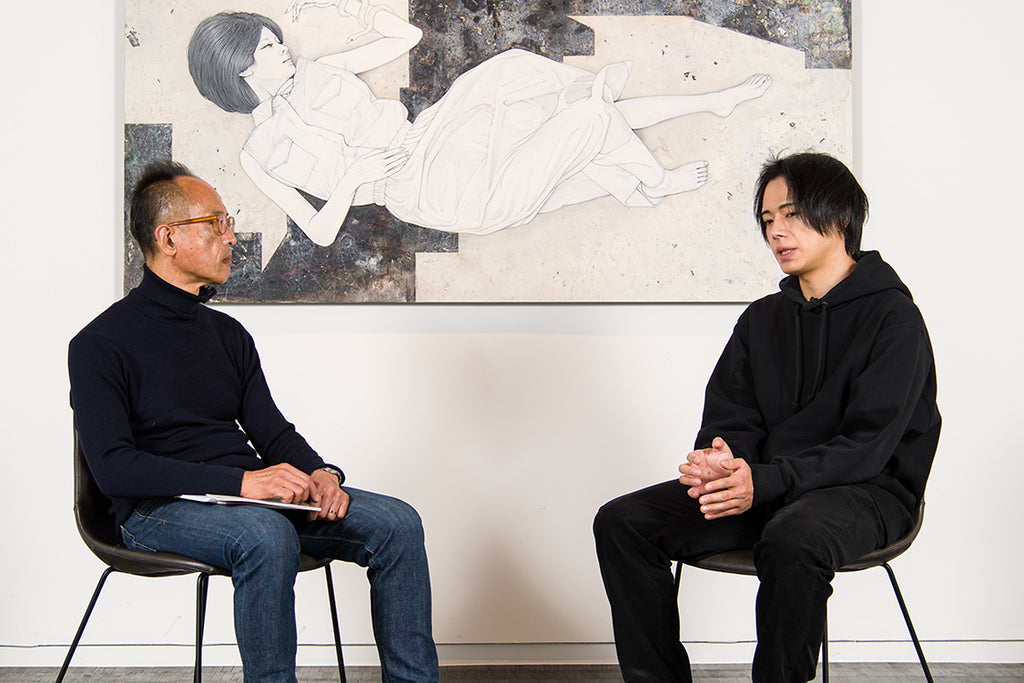
Yu Kawashima × Meiji Hijikata | Exploring the Depths of Young Women's Melancholy in Line Paintings
2024.02.22
INTERVIEW -
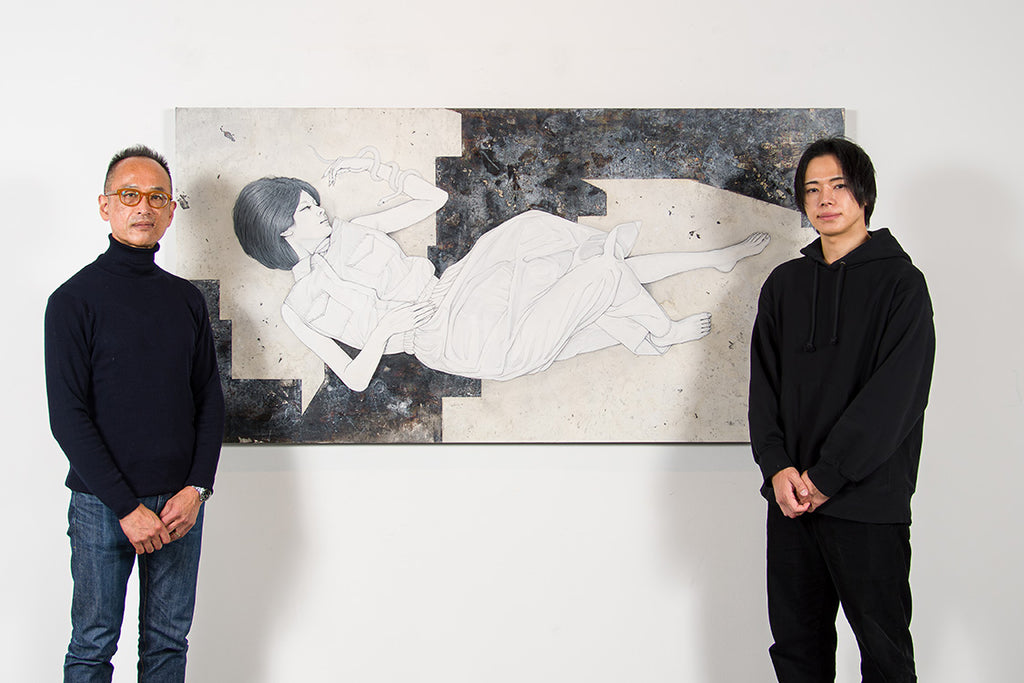
Yu Kawashima × Meiji Hijikata | A World of Ink Beyond the Bounds of Nihonga
2024.2.1
INTERVIEW

ARTICLES CATEGORY

