
ARTICLES
Beautiful Nothing The Work of Tadaaki Kuwayama
A New Appreciation Contemporary Japanese and Asian Art
12/23

A New Appreciation Contemporary Japanese and Asian Art
In our ongoing series, we present the digital archive of the book 'A New Appreciation Contemporary Japanese and Asian Art' This book delves into internationally acclaimed artists and the dynamics of the Asian art market. The twelve introduces Tadaaki Kuwayama.
Aaron Betsky
Former Director of the Cincinnati Art Museum; Architecture and Design Critic
The Pure Presence of Color, Form, and Object
Nothing1 has plagued the arts for centuries. What not to do, how not to represent, what is the art that can escape from the system within it produces, and how to reach the pure state of nirvana, of zen, of enlightenment, or of art itself .these have been issues central to the work of any artist wishing to establishing a critical practice that goes beyond communication their experience of reality. The reasons for this concern range from the philosophical (how to achieve to make the spirit, the holy, or the other present in art)2 to the practical (how to avoid having the work of art become a consumable, and thus the artist a worker whose efforts are alienated)3. They are also profoundly aesthetic, as many artists believe that only by not only not representing, but by not making at all, can they produce an art that would be truly autonomous and beautiful in and of itself. Few artists have spent longer and worked harder to achieve nothing in the last fifty years than Tadaaki Kuwayama.
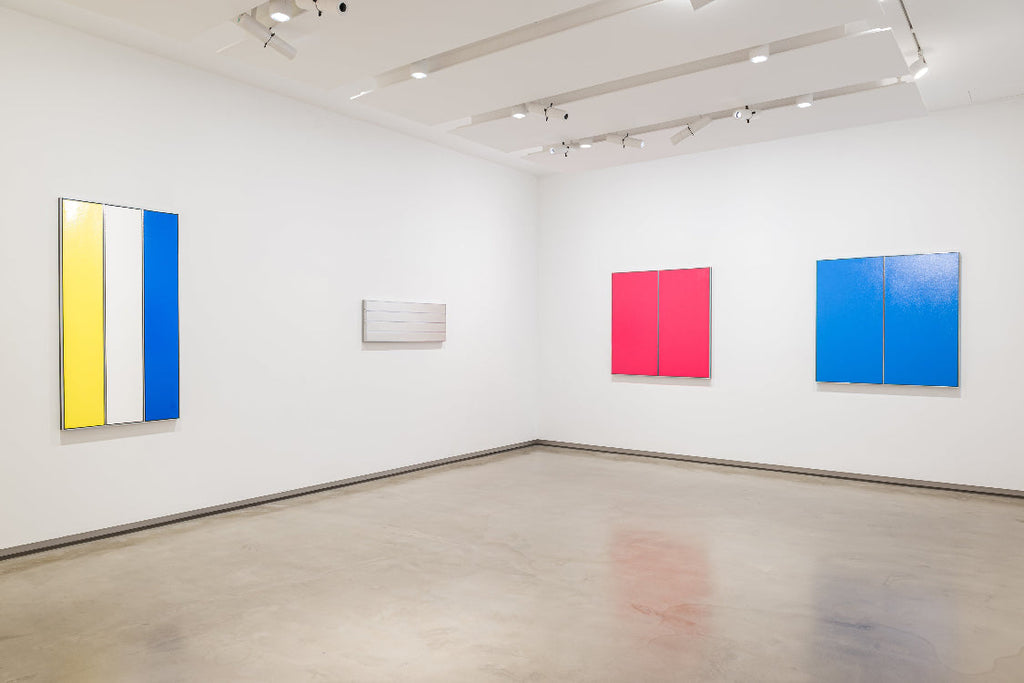
What is ironic — or appropriate, if you follow the logic of the minimalists who are on this quest for nothing, is that what actually appears in the best work that approaches nothing .and this is certainly the case with Kuwayama’s production—is work whose intensity and effect on the viewer is all the greater because of its lack of most what we expect to see in art. Without representation, hierarchy, or materiality, Kuwayama’s paintings and objects become pure color, form, and presence in space. They are luscious and deep in their hues and complete as things exactly because of their lack of reference, but they are also not focal or fetish points. This is exactly what Kuwayama desires to achieve4. He believes that a space appears, a void or nothing that is the art he is making, exactly out of the relationship between the work he has so diligently denuded of any marks of making or art practice in the traditional sense.
Kuwayama embarked on his quest for this space at a moment of minimalism that had arisen in reaction to both previous attempts to find such a nothing and to a previous era in which it was the fulness of art, which is to say its abundance of meaning, gesture, layering, and materiality, that artists felt would allow it to conquer attempts to consume it too easily. He came to that time and place .New York in the late 1950s—with his own history, one that had taught him how to make art that was expressive and referential without being directly representational. Though Kuwayama rejected his training, coming to the United States exactly because he felt restricted by its traditions, the lessons he had learned in the nihonga school5 he attended in the end gave him the discipline, as well as the awareness of the artist as an active composer and maker, that let him work through his rejection of the known with success.
The line of minimalism he entered in New York reached back to the second decade of the 20th century. Although artists had sought to empty and refine their work before this, it was not until Kazimir Malevich, El Lissitzky, Piet Mondrian, and Theo van Doesburg, to name some of the most obvious progenitors of such a work, rejected direct representation with clarity and resolution, that minimalism appeared6. These artists can also stand for the traditional two impulses leading to nothing. While Malevich, for instance, saw his work as a revolution in practice and politics that was at least partially scientific, and which he related to the fundamental explosion of reality through the emergence of quantum physics and other such developments7, Mondrian was driven by a belief in a spirit or oneness of the universe that could only descend on our world through a process of denial.8
None of these artists or their compatriots ultimately held fast to this notion of making nothing. Their work still had a clear materiality and complex composition, even in Malevich’s twin White on White of 1918 and Black Square of 1915. Such a remainder became a recurring issue with minimalist art: artists always stepped back from the brink of whatever form of pure nothing they approached. This is perhaps not surprising. It is difficult for an artist to fully embrace doing nothing and to deny their own authorship. It is a form of suicide, and it is perhaps not surprising that those artists who came closest to their goal – Ad Reinhardt and Mark Rothko come to mind—did so at the end of their lives and in paintings whose blackness evokes an absence that is fully funereal.
The particular minimalist movement of which Kuwayama became, together with Donald Judd, Carl Andre, Anne Truitt, Robert Morris, Mark DiSuvero, and (somewhat later) Sol LeWitt, a founding member, was, even from the beginning, more expressive than many of its predecessors. It was a clear reaction to the macho primitivism and primal instincts of the Abstract Expressionists, but it also sought to offer an alternative to the emergence of a consumer culture that threatened to drown both the public and artists with a surfeit of meaning, materials, and just plain stuff. The minimalism of the early 1960s also evoked, certainly in relation to the writing of certain critics and to the work of movie makers such as Alain Resnais, a sense of the existential meaninglessness of such a culture, especially as the threat of instant annihilation through the atomic bomb was a constant presence. Instead of the positive motivation of building a new, communal, and communist reality, or working towards pure and final enlightenment, this was a minimalism of anger, rejection, and denial9.
Ironically, as James Meyer10 has pointed out, the particular movement that emerged with shows at the Green Gallery in 1963 and then the validating exhibitions of Primary Structures, at the Jewish Museum, and Systematic Painting at the Guggenheim in 1966, were as much part of a broader movements in political activism and consumer culture as they were a reaction against trends in the art world. The turn towards minimalism in couture and music marked the realization by a certain segment of the social and economic elite that the way in which they could set themselves apart was by joining artists in the rejection of popular culture whose mass production and elicitation of quick and emotional responses was seen as the antithesis of what those who truly understood current and future conditions thought was an appropriate art.
Embracing Materials Outside the Tradition of Fine Art
What marked Kuwayama apart from this movement was both the distance he kept from such debates, using his lack of fluency in English as a kind of buffer from the most intense debates and the selling of the work that soon became central to its production itself. Beyond that distance, however, what really marked his work was that he kept going. Though fissures soon appeared in the minimalist movement of the early 1960s, those divisions had to do with modes of expression and materiality: Morris’ expressive sculptures versus Truitt’s pure forms11, for instance. Kuwayama was always the most radical of the group and, when his friends and associates started developing other means to reject or challenge consumerism, he went in a different direction. He tried to find a way to be even more minimal.
The means he chose, however, were an adaptation of technologies that had been developed exactly for the production of large-run and high-affect objects. The first of these was spray paint. A technique that came out of the need for even and large surfaces for industrial and mass production purposes, it was soon adapted by artists involved in more popular forms of work, such as auto detailers and hot rodders (most famously Big Daddy Roth), and those doing illustrations for magazines and architectural renderings. Later, it became the mainstay of the graffiti art movement12. For Kuwayama, it was the first time he used material that thus resolutely did not come out of the high art tradition. He relished the absoluteness of its finish, produced not by stroke, but by the settling of an even mist on the canvas. Layering the colors in the manner in which he had his water-based paints, he was able to achieve the same depth and evenness of color, but without any mark whatsoever of the artist’s hand.
Not somebody to believe in a single-line progression, however, Kuwayama did not merely give up working with paints. He merely added spray paint to his arsenal. The same was true of the three-dimensional pieces with which he started experimenting shortly thereafter. It was here that he first used metal, and it was clear that the integrally colored, machined, and shiny surfaces he was able to achieve using this synthetic material allowed him to approach even closer to the notion of a neutral, high effect but low affect, material. Like a smith testing material at the point of state change to achieve the maximum strength of flexibility of metal result, Kuwayama pushed his bronze and aluminum to be as abstract as his layered paintings, but without their containment on the wall.
He also broke through the limitations of the single canvas by working in series. He had already divided his paintings into separate areas, often squares separated by the thinnest possible aluminum strip, so that they became both objects in themselves and compositions of several, completely equal elements whose uniqueness was in question by their simultaneous presence. Now he began to create works that were either completely the same in series, first of only two or three, but eventually in high numbers, or that exhibited slight differences in tonality. The difference of under painting that shown through in certain lighting conditions, or depending on how you moved past the painting, made the viewer an active participant in the work of art. You could no longer just contemplate the painting and thus have it remain a static, fetishized object. You had to move around, creating both space and time in the work of art.
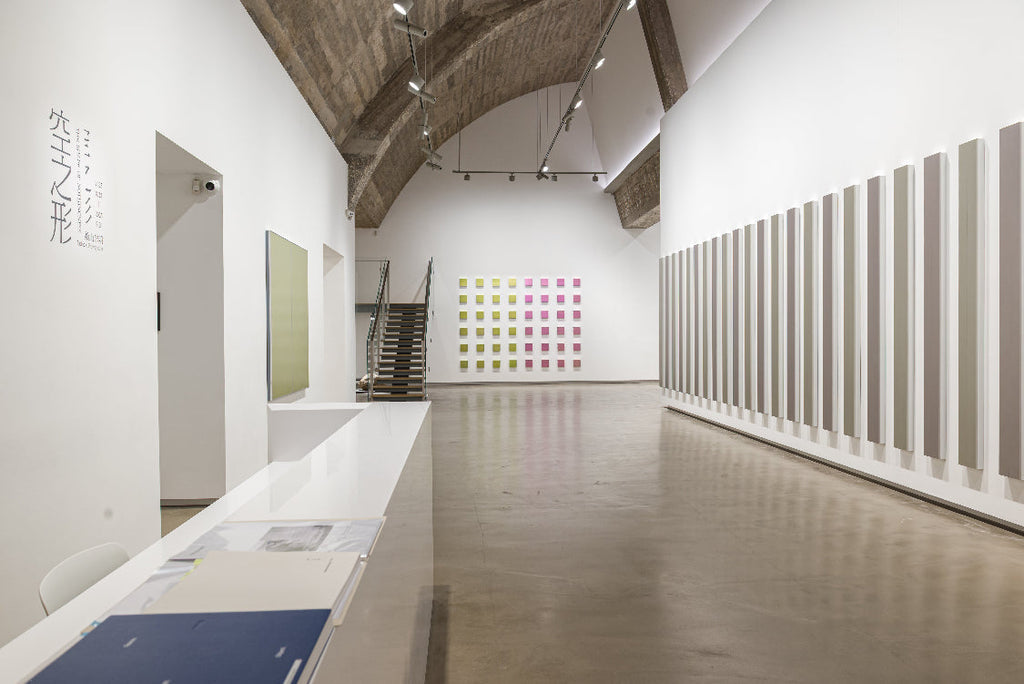
Over time, some of these works became quite heroic in their ambitions, with one series of vertical members expanding to be well over fifty pieces. Once such multiples reached the scale that they began to extend beyond even your peripheral vision, or to even surround you, they took a new dimension. Kuwayama prefers the tall vertical pieces, for instance, to be installed in an L- or U-shape around you, so that the series overcomes any limitations of a single wall and forces you to abandon a purely frontal relation with any one of the pieces. While you at first might have a tendency to look for discrepancies or differences between the different members of the series, soon you find yourself realizing that the difference in shading and reflectivity that occur along their surfaces the artist has worked so hard to perfect are something that is the result of your different relationship to them as you move through the space. The retinal recall you experience then creates a barely perceptible cloud of color that hovers in space, only to dissipate any time you try to catch its existence.
In this, these sculptural works, as well as the lighter of Kuwayama’s single pieces, share a certain affinity (which he acknowledges) to the art produces to the “light and space artists”13 of Southern California. Whereas artists such as James Turrell, Robert Irwin, or Larry Bell sought to dematerialize the work so as to force you to become aware of your own perceptions ( or so their most popular interpreter, Lawrence Wechsler14, claimed), Kuwayama wants the cloud to evaporate, forcing you not to come to terms with either yourself or the works, but the absence of effect – or at least your very inability to define it as such.
Unlike other pursuers of minimalism, moreover, Kuwayama has resolutely eschewed any tendency towards monumentality. When given the ability to install his pieces in site-specific ways in galleries that gave him the freedom to manipulate their spaces, he chose to let the existing conditions continue to exist and dominate, allowing his art to work its seeming magic through perfection, repetition, and lack of affect15. He did not seek to overwhelm you, nor did he pursue the revelation (in the manner of Donald Judd or Richard Serra) of forces larger than you – although he admits that he would be happy to have his pieces exist in a post-human condition – but rather emphasized their presence in relationship to each other and you. Unlike Sol LeWitt, moreover, the series or the geometry never became either the point or the remainder of the work16. For Kuwayama, who also made delicate pieces out of paper that remain in dialogue with the work of his fellow artist and wife, Rakuko Naito, each piece retained an individual presence and sense that it was an autonomous work that, paradoxically, existed through its effect on you.
Discovering a Mode of Production Through “Not-Making”
As Kuwayama has experimented with various techniques and processes, as well as formats, he has found one mode of making that is as close to not-making as he has come. Working with a factory in Japan, he supervises the process of the electrolysis of titanium by which it gains a particular color. His work consists of sitting with the operator and deciding the exact moment he wants the transformation to end, so that one particular hue emerges. Because the color is integral, but also because of the particular qualities of titanium (which architects such as Frank Gehry have also come to appreciate) he is able to achieve a particular iridescence that is all the more remarkable because of the solidity of the material. Cutting the metal into small blocks, he then arrays the pieces in precise grids on the wall, in pairs of closely matched color. Now even the slightest movement of the eye, let alone the head, or a change in the atmosphere of the room, causes the objects to change their aspect. Perhaps ironically, because of the minimalism of the production, these titanium pieces are about as baroque and luscious as Kuwayama has allowed his work to become.
It is in this manner that Kuwayama has perhaps comes closest to nothing. As he often points out, he sees his art as existing in thin air, as a kind of relational aura between the viewer, the work, and the space in which it occurs. The aim he pursues is to not so much make this aura, as to allow it to appear. To make things even more complicated, or closer to nothing, Kuwayama also believes that this particular nothing is both beautiful and valuable, and independent of perception or human beings. Out of the choices the artist makes, but perhaps also out of chance, and certainly out of taste and aesthetic enjoyment, that nothing just somehow, in the end, is.
To see this work, which dates from the last few years, as the endpoint or latest evolution of the artist’s body of work, however, is wrong. Kuwayama has refused to see his work as consisting of an evolution towards to any form or goal or ideal, even if that final end point would be pureness of nothing or the nothingness of purity. Instead, he keeps returning to previous modes of working, as well as rearranging existing pieces. To discard any previous work or give favor to the latest production (though he admits to a fondness, which is common to any creator, for what he has done last), after all, would mean that there is an intrinsic value to the craft of the making, its presentation, or the artist’s other choices in the art making.
Instead, Kuwayama just keeps making. He has an obvious passion for his work, as well as a sense of aesthetics, particular of color and composition, that comes through exactly in the choices he continues to make. He also admits to destroying work that he feels does not live up to his standards. Furthermore, he remains fully committed to playing out all the possibilities of limited formats he has by now established, rather than broadening his body of work to include other media or techniques. However open to new technologies he might be, they must continue his experiments. All this would indicate that he sees value in each work that he makes, and that he uses standards of judgement that define him as the discriminating and privileged creator. Perhaps his most finely-honed art, then, lies in convincing us that all this is as if nothing, and that nothing comes out of it in such a way that it fills our eyes and our spirit with something that, in the end, we still might call art.
Book Information
Title: A New Appreciation Contemporary Japanese and Asian Art (English Edition)
Publisher : Whitestone Co., Ltd.
Release Date : February 26, 2020
*Information in this article is at the time of publication.
1The Flag series is based on universally standardized international maritime signal flags used for communication at sea. Mizú has created a large number of works in this idiom since beginning the series in 1987. This is not necessarily because of simplicity of the color, line, and surface construction.
2For the (mis)interpretation of Zen thought in contemporary art, see; Gregory P.A. Levine, Long Strange Journey: On Modern Zen, Zen Art, and Other Predicaments (Honolulu: University of Hawaii Press, 2017).
3Such theories are usually associated with Marxism and, in art, with the Postwar work Clement Greenberg. See his Art and Culture (New York: Beacon Press, 1961).
4All artist’s comments: conversation with the author, March 15, 2019
5For an English-language history of the school, see Ellen P. Conant et.al., Nihonga: Transcending the Past (London: Weatherhill Press, 1996).
6Generally, “minimalism” did emerge as a term for such reductive art until the 1960s. The term “non-objective” and “abstract” art (coined by the Russian painter Wassily Kandinsky) were used starting in the 1920s and 1930s to describe the general refusal at figuration. It is only in retrospect that we can understand the continuity of this tradition. See Edward Strickland, Minimalism: Origins (Bloomington: Indiana University Press, 1993)
7Malevich actually coined the term “non-objective art” and popularized it in the West in his 1927 The Non-Objective World: Manifesto of Suprematism (New York: Dover Publications, 2003).
8Piet Mondrian, “Neoplasticism in Painting,” in: De Stijl, Vol. 1, No. 12, pp. 140-147, 1925, transl. by Hans L.C. Jaffe in De Stijl (New York: Harry N. Abrams, 1971).
9 See Dore Ashton, The New York School: A Cultural Reckoning (Berkeley: University of California Press, 1992).
10 James Meyer, Minimalism: Art and Polemics in the Sixties (New Haven: Yale University Press, 2001), pp. 24ff.
11 Ibid, pp. 47-56. Although he never reviewed Kuwayama’s work, Michael Fried provided the best ongoing evaluation of the movement in his essays. See Michael Fried, Art and Objecthood: Essays and Reviews (Chicago: University of Chicago Press, 1998).
12 Hilary Greenbaum, Dana Rubinstein, “The Origin of Spray Paint,” The New York Times, November 4, 2011, p. M22.
13 For the best compendium and analysis of the movement, see the catalog of the exhibition organized as part of the first Pacific Standard Time series: Robin Clark, ed., Phenomenal: California Light, Space, Surface (Berkeley: University of California Press, 2011).
14 Lawrence Wechsler, Seeing is Forgetting the Name of the Thing One Sees: A Life of Contemporary Artist Robert Irwin (Berkeley: University of California Press, 1982).
15 In fact, he feels strongly that both Serra’s heaviness and the attempts to create an “almost nothing” by groups such as Zero failed exactly because of their monumentality. Cf. Joseph D. Ketner, Witness to Phenomenon: Group Zero and the Development of New Media in Postwar European Art (London: Bloomsbury Academic Press, 2017).
16 For the best discussion of the devolution of minimalism into conceptual work, see Lucy Lippard, Dematerialization of the Art Object from 1966 to 1972 (Berkeley: University of California Press, 1977).
RELATED ARTICLES
-

Life in New York as an Artist: Harmony of Art, People, and Space
A New Appreciation Contemporary Japanese and Asian Art
23/23 -

Discovering the Essence of Art: Renowned American Artist, Tadaaki Kuwayama
A New Appreciation Contemporary Japanese and Asian Art
22/23 -
Financial Times Chinese Report | A Conversation with Yukio Shiraishi: Art Knows No Borders
2025.11.05
INTERVIEW -
Tadaaki Kuwayama: If "Nothingness" Has a Shape, Perhaps It Is the Instant of "Art"
2025.10.06
INTERVIEW


ARTICLES CATEGORY

