
ARTICLES
Financial Times Chinese Report | A Conversation with Yukio Shiraishi: Art Knows No Borders
2025.11.05
INTERVIEW

This interview was published by Financial Times Chinese. Please refer to its content.
“This art dealer’s reflection on nearly sixty years of experience is a long narrative interwoven with both rationality and emotion—an account that mirrors the tides he has witnessed and the beliefs he continues to hold.”
Interview and text by Zhen Zhu
Our conversation with Yukio Shiraishi took place on a bright morning in August at Whitestone Gallery Beijing in the 798 Art District.
The summer heat outside was fading, and the space itself exuded a sense of austerity and calm, an atmosphere that seemed to reject all impurities. Converted from a Bauhaus-style factory under the direction of Kengo Kuma, the gallery’s entrance retains traces of the architect’s signature textures and forms. Inside, however, most of the structure is defined by arched concrete ceilings and softly toned white walls. At the turn of the staircase stood an installation by Lee Ufan, made of stone, steel plates, and glass—like a subtle keynote, embodying absolute presence while at the same time articulating the Mono-ha aesthetic that anchors the space.
Speaking softly, Yukio Shiraishi, now in his eighties, has largely withdrawn from the frontlines of gallery management. Yet when the conversation turns to the gallery he founded in the 1960s, his 58-year career as an art dealer still brings forth a steady, patient energy.
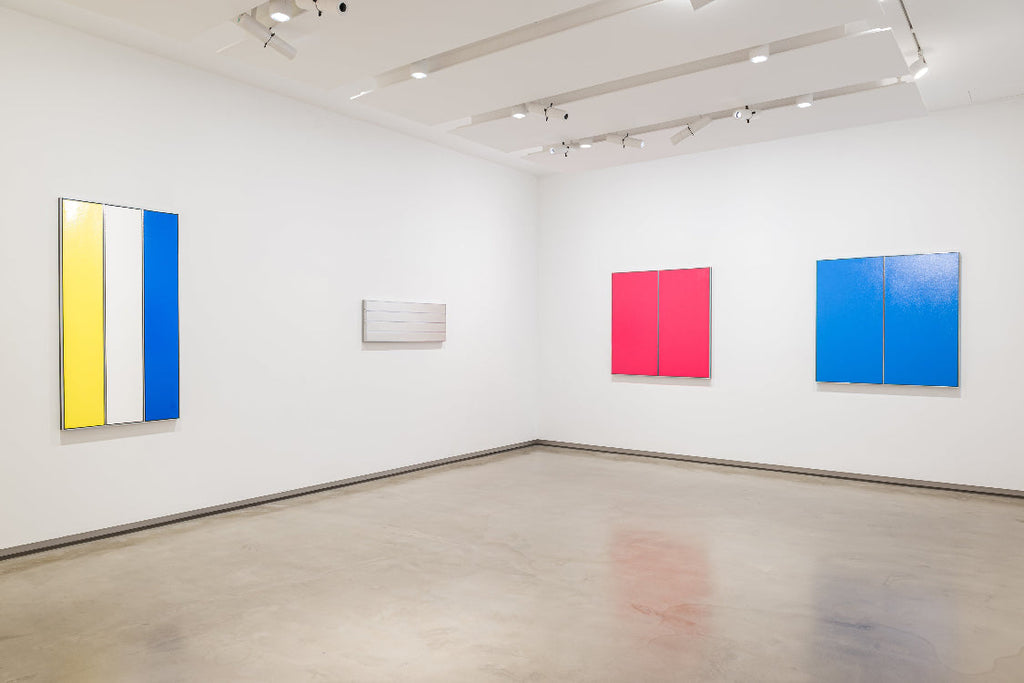
Beside us was a retrospective exhibition of Tadaaki Kuwayama (1932–2023), showcasing 23 works created between the 1960s and 2018—nearly encompassing the artist’s entire career. Trained originally in Japanese painting, Kuwayama relocated to New York in 1958, leaving behind traditional Japanese methods to establish a distinct visual language over six decades, one that had a profound impact on the global minimalist movement.

Tadaaki Kuwayama, The Shape of Nothingness, exhibition installation, Whitestone Gallery Beijing
The works of varying dimensions collectively convey an extreme sense of purity—from the red and blue hues evenly coated with mineral pigments on the canvas to the color blocks of differing sizes created through anodizing titanium, electrolytic coloring, and precise cutting, each possessing the precision of industrial craftsmanship and a spectrum of shifting tones. Arranged across different walls, they exude a calm and detached temperament toward the viewer, yet within them one may also detect a faint trace of rebellion: it is the “emptiness” of an Eastern sensibility achieved by an artist situated at the very core of the Western art world, through an approach that deliberately strips away cultural signifiers.
Tadaaki Kuwayama’s lifelong artistic journey mirrors a distinct chapter in art history: postwar Japan, as a defeated nation, entered a period of economic and cultural reconstruction that set off a wave of intense intellectual and creative ferment. Within the art world, Japanese artists began to reflect on and seek to transcend stagnant traditions while simultaneously confronting the anxiety of identity and presence under the overwhelming influx of Western art. Out of this tension and the interplay of multiple forces emerged a range of artistic movements that embodied both assimilation and resistance.
Whitestone Gallery stands as one of the witnesses to this history. Founded in 1967, it has, through decades of consistent effort, become one of the leading pioneers of Japan’s modern and contemporary art scene. The gallery is particularly recognized for promoting Gutai—an avant-garde art movement that emphasized bold self-expression and radical artistic experimentation—on the global stage in the 2000s, while also dedicating itself to helping emerging Asian artists gain international recognition.
In conversation, Yukio Shiraishi’s recollections of the past unfold in scattered yet expansive fragments. His answers often wander beyond the confines of the questions, drifting freely into reminiscence. With inevitable misreadings and pauses through translation, his narrative feels like a river—one with its own source and destination. Within this current, one can sense both the pragmatic rationality of an art dealer and the occasional trace of sentiment. These interwoven strands of reason and emotion record the surging and ebbing currents witnessed by a gallery that has endured and evolved amid greater tides of change.


Tadaaki Kuwayama, The Shape of Nothingness, exhibition installation, Whitestone Gallery Beijing
The following is an excerpt from the conversation
FT Chinese: Art has been one of the most important pursuits throughout your life. Could you tell us about your earliest experiences with art?
Yukio Shiraishi: My hometown is in Kumamoto Prefecture, Kyushu. When I moved from the countryside to Tokyo at a young age, I held a strong belief in my heart—“A young man should have great ambition.” Looking back now, I realize that I gradually immersed myself in the world of art, which became my true passion, almost without noticing it.
When I first arrived in Tokyo, most of the people who could afford to buy artworks were corporate executives or business owners, and their collections mainly consisted of traditional Japanese art. Traditional Japanese arts, apart from calligraphy, include a range of disciplines: for instance, in fine arts there are Japanese-style paintings and Western-style paintings; the tea ceremony (茶道) , introduced from China, is another form of craft requiring years of discipline; and similarly, martial arts such as kendo (剣道) and judo (柔道) also pursue the ideal of perfection. In short, it was a world defined by various forms of “the Way” (道)
In such an environment, I began to approach galleries with strong financial foundations that specialized in fine artworks. By chance, through an acquaintance from Ōita Prefecture in Kyushu, I started to establish connections with them.
FT Chinese: Looking back, what personal qualities do you think make you well-suited for running an art gallery?
Yukio Shiraishi: Ultimately, it’s the “pursuit of perfection.”
At that time, to reach a state of perfection, everyone threw themselves into a kind of shugyō—(meaning disciplined training or apprenticeship). Joining a company wasn’t seen as “working,” but as “undergoing training.”
The first gallery I worked for had clients such as the president of a shipping company and executives of major real estate firms. The gallery owner possessed exceptional discernment when it came to evaluating artworks. In Japan, the dealer market was already well established—people would trade artworks through what we called kōkan-kai (交換会), or dealer-only auctions. In this field, it didn’t matter whether you had graduated from middle school, high school, or university; everyone was treated equally and started from scratch as an apprentice.
I had originally planned to continue my training at that gallery, but I got married while still a student, so I also had to think about supporting my family. I deeply admired that gallery owner—both his taste and his character. I told him, “I truly respect you and believe I can become your best disciple. You don’t have to pay me, but please allow me to be your external apprentice.”
Thus, at the very beginning of my career in the art world, I had the opportunity to encounter top-quality works—but I had to develop my own clientele, as it would have been inappropriate to encroach on the territories of senior colleagues.
FT Chinese: Pushing Japanese domestic artworks onto the international market was a crucial step in the development of Whitestone Gallery. How did this process begin?
Yukio Shiraishi: After I founded Whitestone Gallery independently, I was the first in Japan to host a group exhibition of artists from the “New York School.” When we speak of the center of the art world, it used to be Italy in ancient times, followed by a long period of Paris dominance. When I started working in the arts, New York had become the new center, and most of the artists I promoted were from the “New York School.” Among them was the Japanese artist Senju Hiroshi, who was considered part of the New York School. So, from 1999 onward, I began preparing a traveling exhibition titled “Beauty Never Ages,” showcasing international artists across Japan.
Compared to China, Japan is a small country, but even so, it has 47 prefectures. With support from local department stores, museums, newspapers, and TV stations, we took this exhibition nationwide.
At the time, there were various art movements. Some tried to provoke reflection by presenting “ugliness”—for example, crushing cars into scrap metal to expose the problems of mechanical civilization. In short, these movements used the display of ugliness to highlight what true art is.
Later, the idea that “art must possess beauty” began to emerge. People started to support the notion that “art cannot be separated from beauty.” As the art center of that time, New York was dominated by abstract expressionism. Abstraction, in essence, was still a pursuit of beauty, only expressed in abstract forms. However, humanity can never be satisfied with pure beauty alone—there is always a longing for some kind of rhythm and tension, which led to the birth of Pop Art.
These changes also made me reflect on how to present “Japanese beauty.” Later, in 2010, we held an exhibition called “The Beauty of Japan” in Russia. At that time, Russian people loved Japanese products, and Japanese people were also fascinated by Russian arts such as circus and ballet.
FT Chinese: Were the results of the exhibition held in Russia in line with your expectations?
Yukio Shiraishi: The exhibition in Russia was initially held at the State Russian Museum in St. Petersburg and later moved to Moscow. It included works by artists we represent, such as Yayoi Kusama, but mainly featured representative pieces from major Japanese art associations at the time.
However, since we did not receive any national-level support, the exhibition was extremely costly. Although we could have sought corporate sponsorship, we insisted on independently promoting all artistic movements using the proceeds from art sales. Under such circumstances, we also held a private preview at the Triump Gallery near Red Square, where the opening reception alone resulted in around 5 billion yen (approximately USD 57 million) in reserved purchases.
But soon after, Russian gallery owners raised a question: “What are these prices based on?” We explained that the pricing referred to the amounts for which the works were sold in Japanese department stores. As a result, the clients responded that since these works were not validated by Christie’s or Sotheby’s, even if they were priced at 50 million or 100 million yen, they were ultimately unwilling to pay due to the inability to assess their value. In contrast, works priced under 5 million yen, which were more suitable as gifts, were successfully paid for. In the end, we only recovered about 500 million yen.
FT Chinese: You once mentioned that compared with European movements such as the “Zero Group,” Japanese “GUTAI” artworks are still undervalued. In your view, what are the factors that restrict Asian artworks from gaining broader market recognition?
Yukio Shiraishi: After the exhibition in Russia, we began preparing for another one in New York. At that time, although we had already encountered works by “GUTAI,” we were only involved with a very small portion of them. In 2013, Alexandra Munroe at the Solomon R. Guggenheim Museum in New York curated an exhibition on GUTAI: “Gutai: Splendid Playground,” but I wasn’t aware of the project at the time.
In the same year, at The Armory Show in New York, we faced the question: what kind of artworks should we bring to ensure financial returns? When we had held the exhibition in Russia, although the number of visitors was very impressive, none of the expensive works were sold, which was quite frustrating. So we decided to bring works that could achieve cost recovery in New York. It happened that the fair organizers promised us that if we could bring “GUTAI” works, they would give us the most central exhibition zone and increase our display space. In the end, we chose to bring “GUTAI” works to the fair.
It was only then that I realized that “GUTAI” works had previously been acquired by European gallerists and circulated into the American market through Europe. As a defeated nation after World War II, Japanese artworks were not directly accepted by the U.S. market—at least not on the surface.


Tadaaki Kuwayama, The Shape of Nothingness, exhibition installation, Whitestone Gallery Beijing
FT Chinese: How would such circumstances affect the artists?
Yukio Shiraishi: The works currently on view at Whitestone Gallery’s Beijing space are by Mr. Kuwayama (Tadaaki Kuwayama). When he first gained attention at Green Gallery in New York, it also sparked some recognition in Japan. However, at that time, Mr. Kuwayama, despite developing his career in New York, was not particularly prioritized or promoted by the gallery due to his identity as a Japanese artist.
This situation did not happen to him alone. As a defeated nation after World War II, Japan’s historical context meant that many Japanese artists who later developed careers in New York faced similar challenges. For instance, Jackson Pollock’s drip painting method—he himself once said: “This dripping technique wasn’t my invention. The Japanese had already been doing it: the GUTAI artists were practicing this approach even earlier.”
FT Chinese: Would you say that GUTAI’s artistic creation is an Eastern or a Western concept of art?
Yukio Shiraishi: The GUTAI artists first exhibited in Ashiya Park in Japan. A Japanese artist who had spent time in Paris once advised Yoshihara Jirō (the founder of GUTAI): “You must not imitate others; you must do what no one has done before.” Japan’s traditional method of learning art has always been to imitate the teacher. By mimicking the teacher, one could improve. But in any field—especially in the realm of contemporary art—relying purely on imitation gains no recognition.
What made GUTAI special was ultimately their remarkable boldness and avant-garde nature. At that time, similar movements were emerging around the world, but to officially become a member of GUTAI, one had to create something that had never been done before.
Take Shiraga Kazuo, for example, who poured paint into a sand pit and fought with it using his body. Or take Shozo Shimamoto, a core member, who was always said to “lack a personal style.” One day, he thought using canvas was too expensive, so he pasted newspaper onto a frame. One morning, he touched the paper with freshly washed hands and noticed how easily the newspaper tore. He thought this might gain Yoshihara Jirō’s approval, so he immediately brought the “work” to show him. At the time, Japanese people still knew nothing of Lucio Fontana, and it was only later that they discovered Shimamoto’s act of puncturing newspaper predated Fontana.
GUTAI was born in Kansai, not Tokyo. As a regional art collective, it was hard to gain recognition in Japan during that era. So even when they came to Tokyo, they were not accepted. Only because they later gained recognition abroad did GUTAI begin to find its way onto the global stage.
FT Chinese: The global art market is currently going through a difficult period. Especially this year, we frequently hear news of various art institutions encountering hardships. As someone running a gallery with a 58-year history, what is your view on "long-termism"?
Yukio Shiraishi: On this path of running a gallery, I have experienced many failures and also many successes. In Japan, there were years when the sales of our gallery alone matched the total sales of dozens of ordinary galleries. But to have come this far, I believe it should be attributed to the favor of the environment.
About twenty years ago, we invested in building a museum in Karuizawa, intending to use it to promote art to the world. At the time, we also purchased the surrounding land, and later the value of that land increased. Later still, during the COVID-19 pandemic, when the art market faced severe challenges, we managed to get through the difficult period by selling part of that land.
FT Chinese: On this road of running a gallery, have there been any principles that you have consistently adhered to?
Yukio Shiraishi: Everything (we do) is based on the principle of peace.
Next, Whitestone Gallery is preparing to host an exhibition in Japan titled “Love and Art Know No Borders,” and we plan to successively hold such exhibitions around the world. If you read the newspapers lately, although the wars in various places are seemingly progressing toward resolution, the overall situation is still far from optimistic. I hope all nations can invest more energy and budgets into peaceful industries like music, fine art, and sports. You could say “Love and Art Know No Borders,” or you could say “Love and Art Can Save Humanity.” The original intention is simply to promote the development of art with this core theme.
FT Chinese: How would you describe the business of running a gallery? What aspects of this work are the most encouraging for you? And what parts are the most troublesome?
Yukio Shiraishi: For galleries, cultivating artists is extremely important. Now, many artists from mainland China, Taiwan, Hong Kong, as well as Singapore, Malaysia, and Indonesia have also grown through the promotion of Whitestone Gallery. Rather than calling ourselves a Japanese gallery, we are actually an Asian gallery. We hope to bring art and exhibitions to all corners of the world.
About 30 years ago, I came to Beijing together with my academic mentors, Tatsuo Takayama and Ikuo Hirayama, among others. At that time, we also participated in the first exhibition on Impressionist art ever held in Beijing. Back then, there was no such profession as an “art dealer” in China. After entering the secondary market directly, the prices of Chinese artists’ works would sometimes spike dramatically and then fall just as quickly. In the end, it is still essential to nurture a gallery system. Without doing so, artists cannot be preserved in history.
I know that even earlier, some Japanese galleries had already entered the Chinese mainland market. At that time, we had not yet arrived. But after the pandemic, while many international galleries were leaving, we opened our Beijing space. Ms. Bei Wan made a tremendous effort to open the gallery here.
Yesterday, I went to China Guardian Art Center to see an exhibition about ancient culture. I feel that truly remarkable art always emerges in harmony with nature. China has had many historical dynasties, especially during the Tang and Song periods, which produced outstanding works of art. China was once a great country; now it is a great country, and it will become even better in the future. I also see in each of my colleagues the spirit of cultural inheritance.
The views expressed in this article are solely those of the interviewee. All images used in this article are provided by the artist and Whitestone Gallery. Author and editor contact: zhen.zhu@ftchinese.com
RELATED ARTICLES
-
Tadaaki Kuwayama: If "Nothingness" Has a Shape, Perhaps It Is the Instant of "Art"
2025.10.06
INTERVIEW -

Echoes of Silence: Tadaaki Kuwayama & Rakuko Naito's Minimalist Exploration
2024.02.09
FEATURE -

Life in New York as an Artist: Harmony of Art, People, and Space
A New Appreciation Contemporary Japanese and Asian Art
23/23 -

Discovering the Essence of Art: Renowned American Artist, Tadaaki Kuwayama
A New Appreciation Contemporary Japanese and Asian Art
22/23


ARTICLES CATEGORY

